
Serve a chilled Oeil-de-Perdrix as an apéritif or with a summer meal: this salmon-pink Pinot Noir rosé is delicate, fruity and lively. It was born in the canton of Neuchâtel and is now also made in the Valais and other French-speaking cantons. On Helvitic you will buy it straight from the wineries; orders open soon.
Oeil-de-Perdrix, the Swiss Pinot Noir rosé
A rosé born in Neuchâtel, made from a single grape
On this page
What does Oeil-de-Perdrix mean?
Literally «partridge eye». Here it names a salmon-pink rosé. In Italy, a Vin Santo made mostly from Sangiovese carries the words Occhio di Pernice, which means the same.
According to Swiss Wine Valais, the Valais wine trade body, the colour of Oeil-de-Perdrix ranges from slightly golden to clearly salmon.
In French the phrase also means a corn between the toes, so you may find foot-care pages when you search for it. Nothing to do with wine.
How is Oeil-de-Perdrix made?
From Pinot Noir only. The grapes are red but their juice is clear: the colour sits in the skin. For a rosé, the juice stays in contact with the skins only briefly before fermentation, a step called maceration, then the skins are removed. The longer the maceration, the deeper the colour.
Swiss Wine Valais stresses that it is a wine in its own right, not a by-product of red wine making.
Do not confuse it with a Blanc de Noirs, a white wine made from red grapes pressed straight away, before the juice takes on any colour.
Where is Oeil-de-Perdrix made?
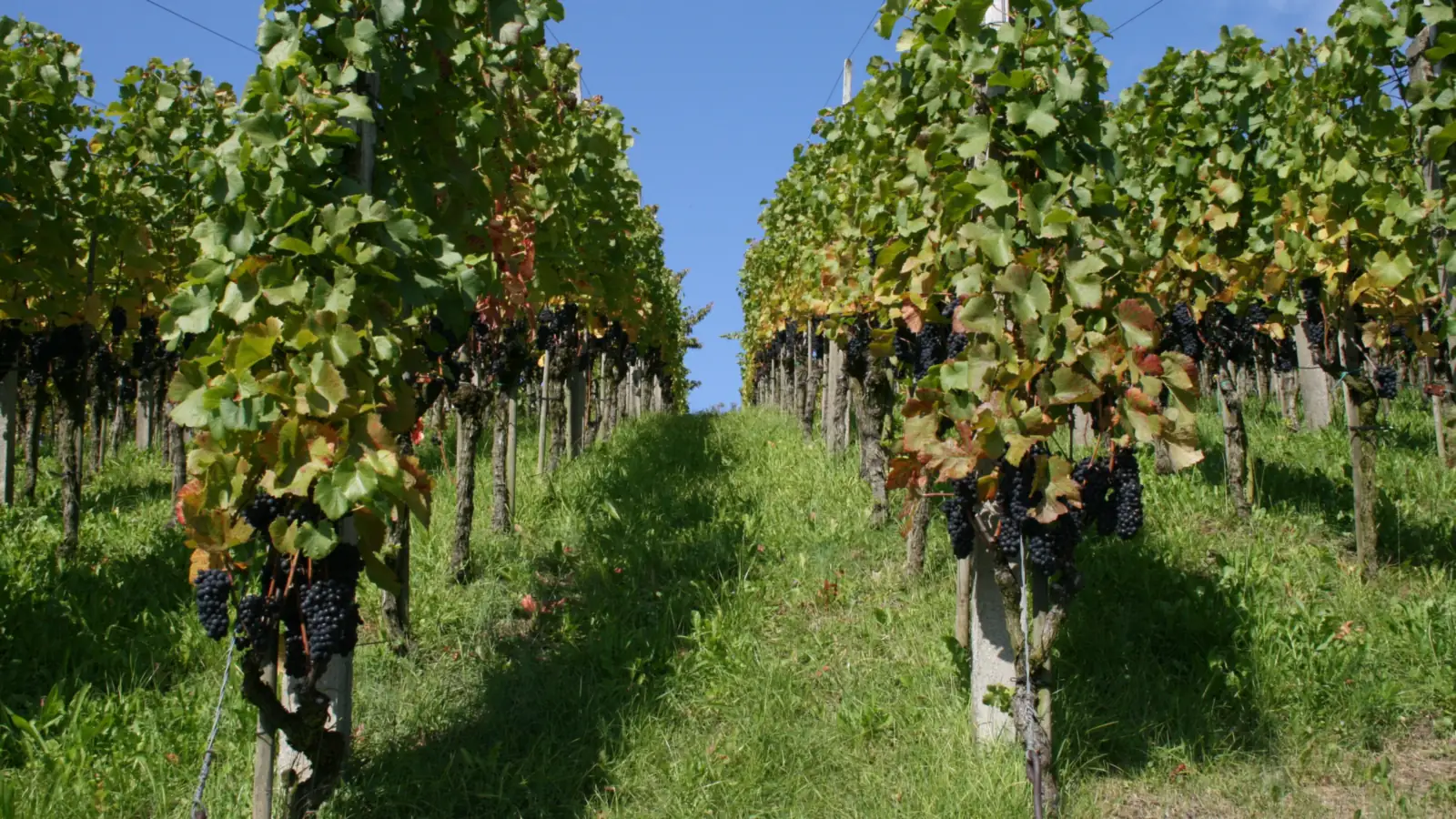
It was born in Neuchâtel, where Pinot Noir is the most planted red grape, according to Swiss Wine Promotion, the body that promotes Swiss wine. It then spread to other French-speaking cantons.
In the Valais, the name «Œil-de-Perdrix du Valais» has applied since 1963 to a rosé made from Valais Pinot Noir.
The Federal Office for Agriculture (FOAG) does not count Oeil-de-Perdrix separately: it records planted Pinot Noir, whether it ends up red or rosé. The charts on this page therefore show Pinot Noir; Neuchâtel is the third canton for it, after the Valais and Vaud.
What to eat with it, and at what temperature?
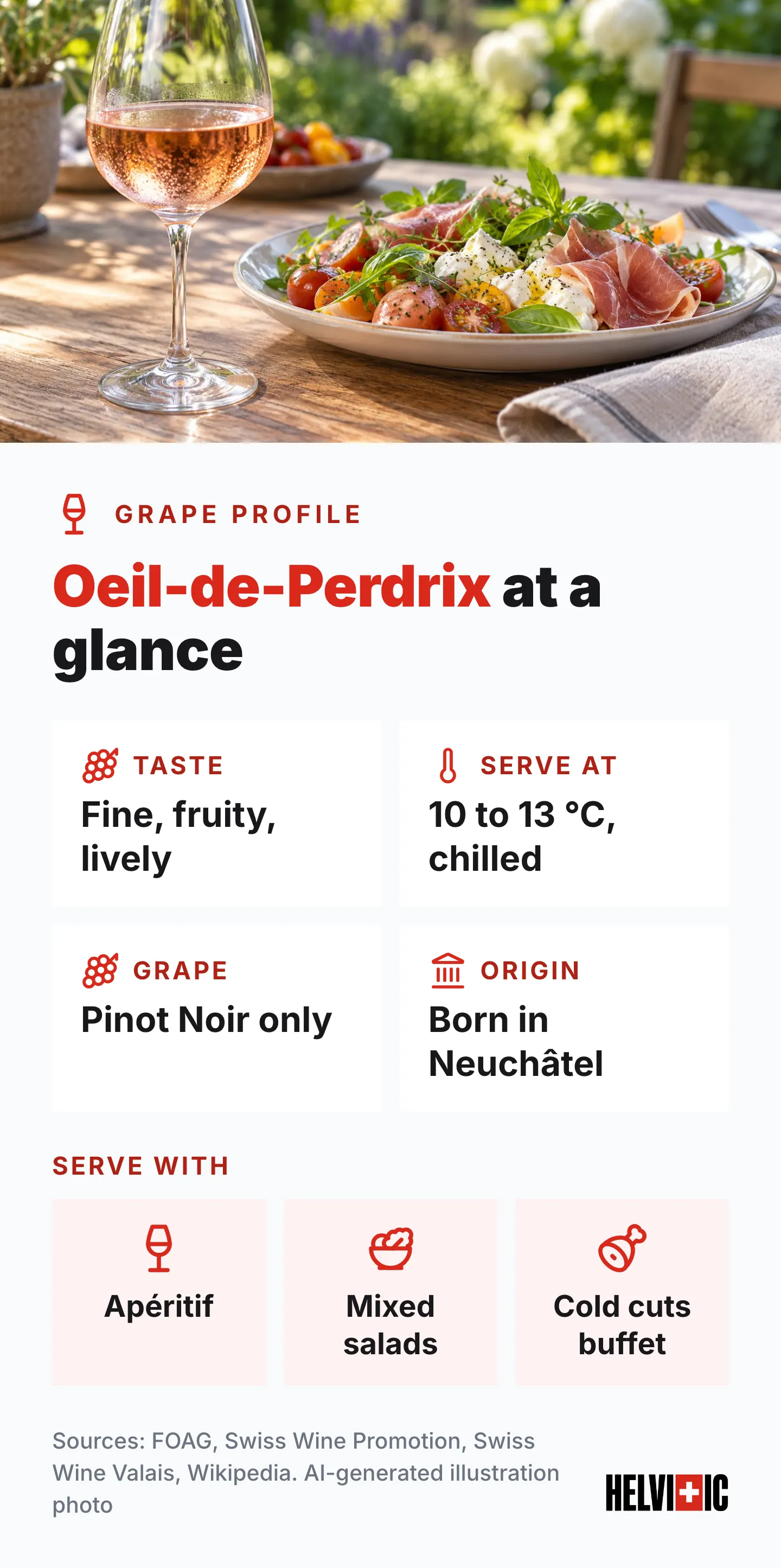
Serve it as an apéritif or with a summer meal: cold dishes, mixed salads, a country buffet, as Swiss Wine Valais suggests. Its liveliness refreshes and its delicacy does not cover light food.
Serve it chilled, at 10 to 13 °C, the range Swiss Wine Valais gives for rosé; in high summer it can go a little colder.
Vineyard area in Switzerland
The FOAG counts Pinot Noir as planted, whether it is made into red or rosé: Oeil-de-Perdrix has no line of its own in the statistics.
Pinot Noir: official 2025 figures
- Area in Switzerland
- 3,594.3 ha
- Share of the Swiss vineyard
- 24.9 %
- Rank among red grapes
- 1st of 172
Key points
- Rosé made only from Pinot Noir, salmon-pink in colour.
- Born in Neuchâtel; in the Valais the name has been in use since 1963.
- Its colour comes from a short maceration of the juice with the skins.
- As an apéritif and with summer dishes, at 10 to 13 °C.
- The FOAG counts it within planted Pinot Noir, with no line of its own.
- On Helvitic, orders open soon, straight from the wineries.
Frequently asked questions: Œil-de-Perdrix
Is Oeil-de-Perdrix a grape variety?
No, it is a type of wine: a rosé made from the Pinot Noir grape. Our Pinot Noir page covers that grape, the most planted in Switzerland.
How is it different from other rosés?
The grape. A rosé can come from any red grape; Oeil-de-Perdrix is made from Pinot Noir only.
Is Oeil-de-Perdrix always a rosé?
Yes, by definition, with a colour from slightly golden to clearly salmon according to Swiss Wine Valais. A white wine made from Pinot Noir is called a Blanc de Noirs.
Sources
- Federal Office for Agriculture (FOAG), «L’anno viticolo 2025», Statistiche vitivinicole, as of November 2025 (PDF)
- Swiss Wine Promotion, Three Lakes wine region (Œil-de-Perdrix, created in Neuchâtel), checked on 21 October 2026
- Swiss Wine Promotion, grape variety profile: Pinot Noir, checked on 21 October 2026
- Swiss Wine Valais, Oeil-de-Perdrix (colour, maceration, food pairings), checked on 21 October 2026
- Swiss Wine Valais, serving temperatures (rosé), checked on 21 October 2026
- Wikipedia (German), Œil de Perdrix: Neuchâtel, Valais designation of 1963, Occhio di Pernice, Hühnerauge, checked on 21 October 2026
- Wikipedia (German), Blanc de Noirs, checked on 21 October 2026