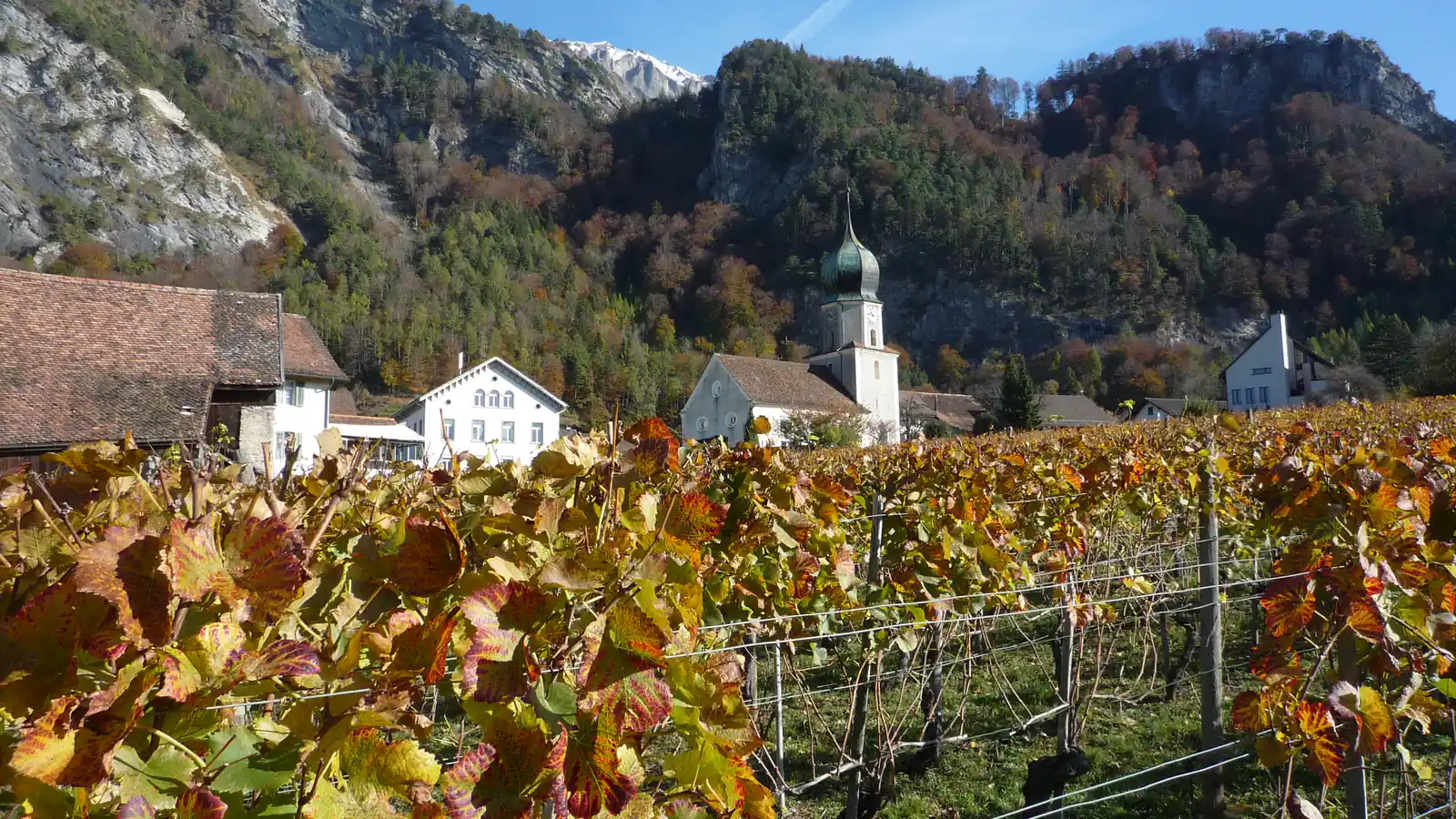
To taste Bündner Herrschaft wine, pick a Pinot Noir from its four villages north of Chur: Fläsch, Maienfeld, Jenins and Malans. Pinot Noir, called Blauburgunder here, covers two-thirds of the 422 hectares of vines in Graubünden in 2025, according to the Federal Office for Agriculture (FOAG).
The foehn, a warm wind coming down from the Alps, makes it the warmest wine region in German-speaking Switzerland, according to Swiss Wine Promotion. Malans also grows a white rarity: Completer.
Where is the Bündner Herrschaft?
In the Rhine valley in northern Graubünden (Grisons), between Chur and the border with St. Gallen. The Bündner Herrschaft covers the communes of Fläsch, Maienfeld, Jenins and Malans, and most of the canton's vineyards are here.
Graubünden has 422 hectares of vines excluding Mesolcina in 2025, according to the FOAG. Mesolcina, an Italian-speaking valley south of the Alps, adds 28 hectares, mostly Merlot, which the statistics count with Italian-speaking Switzerland. Graubünden Wein, the canton's wine association, notes that the area has doubled in fifty years, from about 200 hectares in 1970.
Why does Pinot Noir do so well here?
The foehn is the key. This warm, dry wind blows down from the Alps in autumn; Swiss Wine Promotion, the body that promotes Swiss wine, calls it the grape cooker. It extends the ripening of the grapes. Soils are rich in limestone, often calcareous schist, according to Graubünden Wein.
The result is a Pinot Noir that Graubünden Wein describes as Burgundian in style, sometimes fruit-driven, sometimes aged in barrels for keeping. It covers 281 hectares according to the FOAG, two-thirds of the vineyards.
Its history here is partly legend. According to Graubünden Wein, Blauburgunder is said to have been brought in around 1630 by young mercenaries back from service in Burgundy; before that, mostly white grapes were grown. Our Pinot Noir page covers the grape in detail.
Which white wines should you try in Graubünden?
White grapes make up about 29% of the vines. Müller-Thurgau (Riesling-Sylvaner) is the most planted, but the best-known whites are made from Chardonnay, according to Graubünden Wein. They are often made without malolactic fermentation (the second fermentation that softens acidity) and with a touch of residual sugar, which keeps them fresh.
The local rarity is Completer, an old, very acidic white grape. Swiss Wine Promotion cites a Completer vineyard in Malans in a document from 1321; according to Graubünden Wein, the canons of Chur drank it after Compline, the evening prayer. It covers 9.8 hectares in Graubünden according to the FOAG, more than half of all Swiss Completer. Our Completer page tells its story.
A very old vineyard
The oldest record of winegrowing in Graubünden dates from 765: in his will, Bishop Tello of Chur left a vineyard near Ilanz to the monastery of Disentis, recalls Graubünden Wein. In the Middle Ages, vines grew up to 1,200 metres, even in the Bündner Oberland and the Lower Engadine.
Today Graubünden's winegrowers make more than 60 wines from over 42 grape varieties, according to the association. A third of the canton's vineyard is farmed organically, according to 2025 Federal Statistical Office data published by Bio Suisse.
Visiting and tasting in the Bündner Herrschaft
More than 40 kilometres of signposted paths link Chur and Fläsch through the vines, past wineries and Torkel, the local name for press houses and cellars, according to Graubünden Wein. In Jenins, a short trail with eight panels around the old Torkel explains grapes, history and winegrowing.
The association also offers a backpack tasting: three wines to enjoy on a walk, with an audio guide. Through the year, wine festivals liven up Fläsch and Maienfeld.
Graubünden wine on Helvitic
Helvitic connects wineries and wine lovers directly, with no reseller in between. Sales are not open yet: payment is still being tested. Meanwhile you can browse the Graubünden wineries already on Helvitic, save them as favourites and follow them to hear about new wines and events.
Once ordering opens, you will order in multiples of 6 bottles; every bottle will ship straight from the winery that made it, delivered to you or ready for pick-up at the cellar.
The vineyard in figures
Graubünden, excluding Mesolcina
Vineyard area
422.2 ha
Share of the Swiss vineyard
2.9 %
White and red
29% / 71%
Graubünden, excluding Mesolcina: the most planted grapes in 2025
Source: Federal Office for Agriculture (FOAG), «L’anno viticolo 2025», Statistiche vitivinicole, tables 1.2 and 1.3, as of November 2025. Hectares rounded to one decimal (published in ares). Shares calculated by Helvitic, first on the area of the region, then on the total Swiss vineyard area (14,431.0 ha). Read the statistics (PDF in Italian)
Key points
The Bündner Herrschaft: Fläsch, Maienfeld, Jenins and Malans, north of Chur.
422 ha of vines in Graubünden excluding Mesolcina in 2025, twice the 1970 area.
Pinot Noir (Blauburgunder) covers two-thirds of the vines, ripened by the foehn.
Completer, a rare white recorded in Malans in 1321, covers 9.8 ha.
A third of Graubünden's vineyard is farmed organically in 2025.
More than 40 km of trails through the vines, from Chur to Fläsch.
In the Rhine valley north of Chur, in the communes of Fläsch, Maienfeld, Jenins and Malans. It is Graubünden's main wine region.
Which red wine should I try in Graubünden?
A Pinot Noir, known locally as Blauburgunder: it covers two-thirds of the canton's vineyards according to the FOAG. Graubünden Wein describes it as sometimes fruit-driven, sometimes barrel-aged for keeping.
What is Completer?
An old, very acidic white grape, rare and grown mainly in Malans. Swiss Wine Promotion traces it to a document from 1321; it covers 9.8 hectares in Graubünden according to the FOAG.
Why does the foehn matter for Graubünden wine?
Because this warm, dry wind extends the ripening of the grapes in autumn. Swiss Wine Promotion calls it the grape cooker and credits it with making the Bündner Herrschaft the warmest wine region in German-speaking Switzerland.