
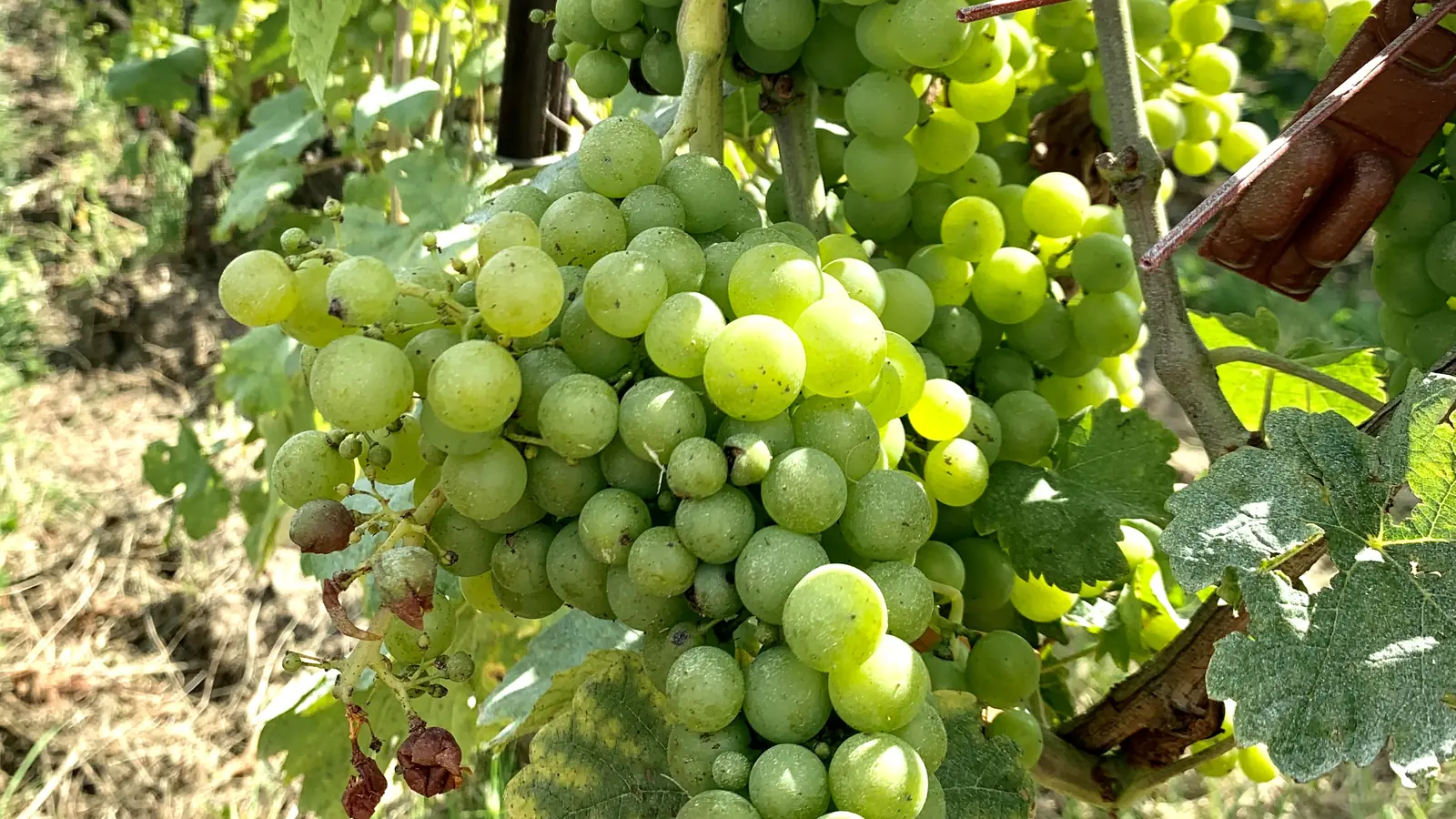
Pick a Chasselas for apéritif, fondue or lake fish: this dry, light white, with notes of lime blossom, pear and apple, never overpowers the food. It is the most planted white grape in Switzerland, mainly in Vaud and the Valais. On Helvitic you will buy it straight from the wineries; orders open soon.
Chasselas, the white wine of French-speaking Switzerland
A discreet grape that changes its name and taste from one slope to the next
On this page
What does Chasselas taste like?
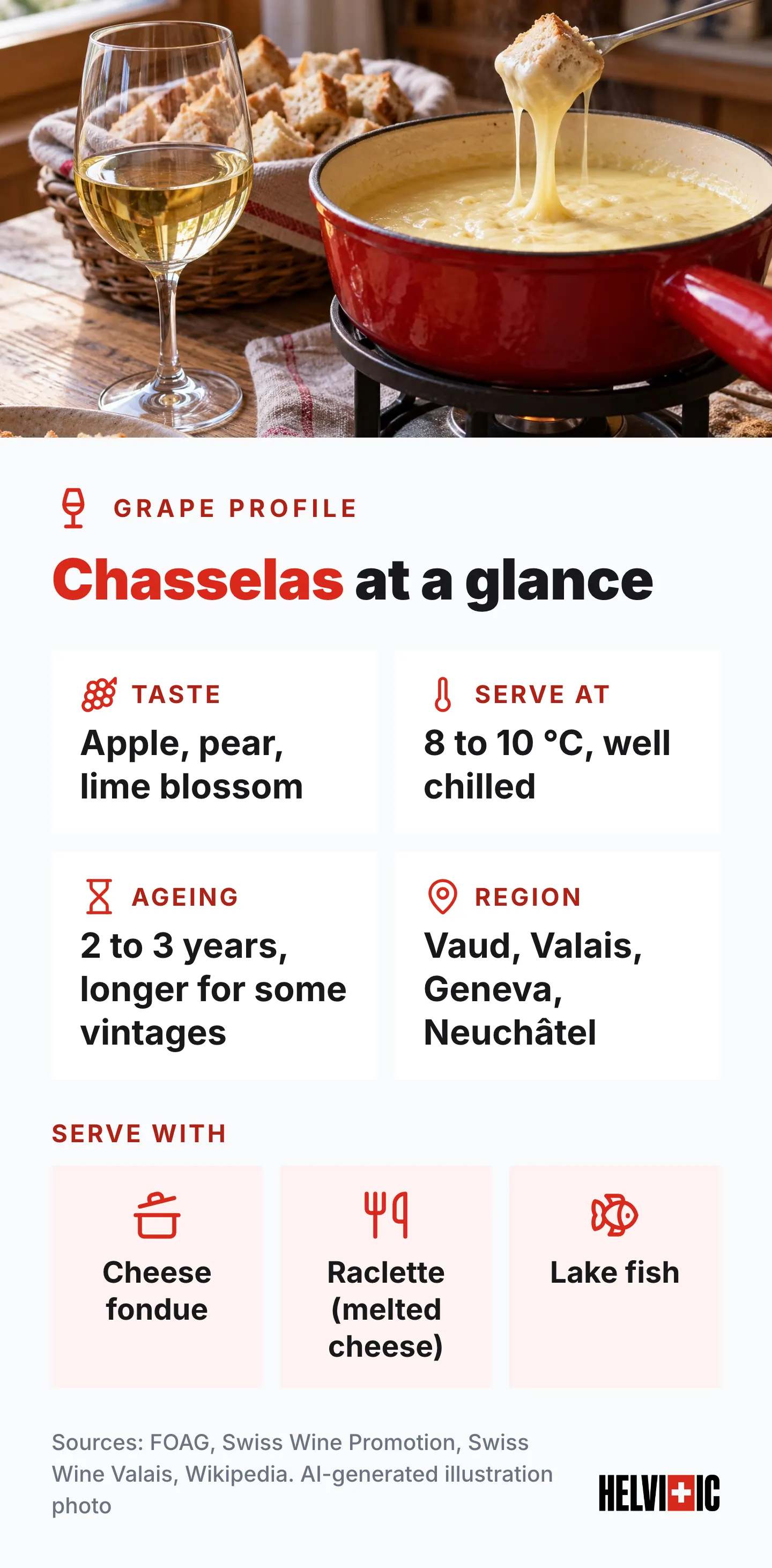
Chasselas makes a dry, light white with discreet aromas. Swiss Wine Promotion, the body that promotes Swiss wine, describes notes of apple, pear and citrus, floral hints of lime blossom or acacia, and often a mineral touch reminiscent of stone.
Taste it next to a Chardonnay to see the difference. Swiss Wine Valais, the Valais wine trade body, counts Chasselas among the fairly neutral grapes, while Chardonnay mostly shows how it was made, in steel tanks or oak barrels. That restraint lets the soil come through: two Chasselas from different villages can taste quite unlike each other.
Some Chasselas keep a slight spritz, a hint of carbon dioxide that barely tingles on the tongue. Swiss Wine Valais often mentions it for Fendant, the Valais Chasselas.
Where does Chasselas grow, and under what name?
According to the Federal Office for Agriculture (FOAG), Chasselas is the most planted white grape in the country. Almost two hectares out of three are in the canton of Vaud and just over one in five in the Valais; Geneva and Neuchâtel come far behind. The charts on this page give the exact areas.
The name changes with the region, the grape does not. In the Valais it is called Fendant. In Geneva, the name Perlan is also used for Chasselas. In Vaud the label puts the place first: an Yvorne, a Féchy, an Épesses or a Dézaley is a Chasselas, even when the grape is not written on the bottle.
In Neuchâtel it becomes a local speciality, the Non-Filtré: a Chasselas bottled without filtration, so slightly cloudy. In Germany the same grape is called Gutedel.
Where does Chasselas come from?
Most likely from the shores of Lake Geneva. Genetic studies published in 2009 place its probable origin in the Lake Geneva area, most likely Vaud, where the greatest variety of forms of this grape was recorded in the 19th century. Swiss Wine Promotion also considers it to be from there.
Swiss Wine Promotion dates the first references to the 17th century: a work by the botanist Bauhin mentions it in 1612, already under the names Fendant and «Lausannois». Today the Lavaux terraces, where Chasselas is the signature grape, have been a UNESCO World Heritage site since 2007.
What to eat with Chasselas?
Serve it with fondue, raclette or a cheese croûte. Its gentle acidity balances the creaminess of melted cheese, so each mouthful stays fresh.
It also suits lake fish such as trout or féra (a whitefish from Swiss lakes), whose delicate taste it does not cover, and shellfish. As an apéritif, its lightness makes it easy to drink. Our French and German articles on wines for fondue and raclette compare it with other Swiss whites.
How to serve it, and how long to keep it?
Serve it at 8 to 10 °C, as Swiss Wine Promotion recommends. Too cold and its subtle aromas vanish; too warm and it feels flat. Put a warm bottle in the fridge for 30 minutes, take a cold one out 30 minutes before serving: that is the 30/30 rule given by Swiss Wine Valais.
Most Chasselas are drunk within two or three years, for their freshness. Some vintages last ten years or more and then develop notes of beeswax, sweet spices and dried fruit, according to Swiss Wine Promotion.
Vineyard area in Switzerland
Chasselas: official 2025 figures
- Area in Switzerland
- 3,415.6 ha
- Share of the Swiss vineyard
- 23.7 %
- Rank among white grapes
- 1st of 142
Key points
- Dry, light white: apple, pear, lime blossom, sometimes a mineral touch.
- The most planted white grape in Switzerland, mainly in Vaud and the Valais.
- Called Fendant in the Valais; in Vaud the label often shows the place name.
- Good with fondue, raclette, lake fish and as an apéritif.
- Serve at 8 to 10 °C; drink within two or three years, longer for some vintages.
- On Helvitic, orders open soon, straight from the wineries.
Frequently asked questions: Chasselas
What is Chasselas wine?
A white wine made from the Chasselas grape, grown mainly in French-speaking Switzerland. It is dry, light and discreet, and reflects the place where the vines grow. According to the FOAG it is the most planted white grape in Switzerland.
Is Chasselas the same as Fendant?
Yes, as far as the grape goes. Fendant is the Valais name for Chasselas, reserved for wines from that canton since 1966 according to Swiss Wine Promotion. Our Fendant page explains the details.
Is Chasselas sweet or dry?
Dry. Swiss Wine Promotion describes it as dry and harmonious, with light acidity. Some bottles have a slight spritz, but it is not a sparkling wine.
Is Chasselas the same grape as Gutedel?
Yes. Gutedel is the name used in Germany. In Switzerland people say Chasselas, and Fendant in the Valais.
Sources
- Federal Office for Agriculture (FOAG), «L’anno viticolo 2025», Statistiche vitivinicole, as of November 2025 (PDF)
- Swiss Wine Promotion, grape variety profile: Chasselas, checked on 21 October 2026
- Swiss Wine Promotion, Vaud wine region (Lavaux, UNESCO 2007), checked on 21 October 2026
- Swiss Wine Promotion, Three Lakes wine region (Non-Filtré), checked on 21 October 2026
- Swiss Wine Valais, Fendant (slight sparkle), checked on 21 October 2026
- Swiss Wine Valais, Heida: aromatic and neutral grape varieties (Chasselas, Chardonnay), checked on 21 October 2026
- Swiss Wine Valais, serving temperatures (30/30 rule), checked on 21 October 2026
- Wikipedia (French), Chasselas (cépage): origin, Bauhin 1612, Perlan, Chasselas de Moissac, checked on 21 October 2026