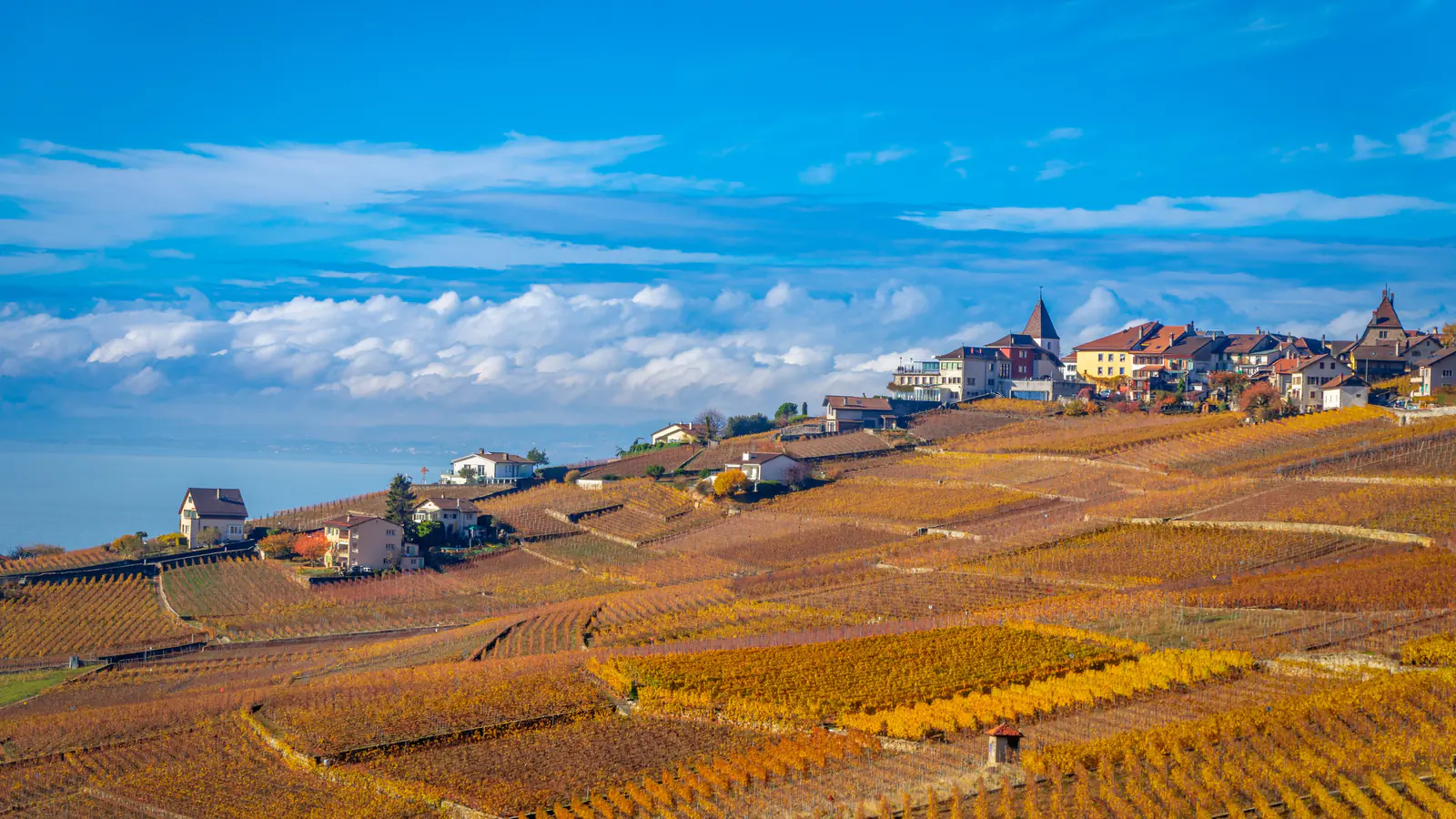
To choose a Vaud wine, look first at the place name on the label: a Yvorne, an Épesses or a Dézaley is almost always a Chasselas, even when the grape is not mentioned. Vaud is Switzerland's second-largest wine canton, with 3,749 hectares of vines in 2025 according to the Federal Office for Agriculture (FOAG).
It is also the only large Swiss wine region where white wine dominates: 65% of the area. Chasselas alone covers 58% of the canton's vines, and nearly two-thirds of all Swiss Chasselas grows in Vaud.
Where are the Vaud vineyards?
The vineyards span six regions between Lake Geneva and the lakes of Neuchâtel and Morat, according to Swiss Wine Vaud, the canton's wine trade body. Along Lake Geneva lie La Côte, between Nyon and Lausanne; Lavaux, between Lausanne and Chillon Castle; and the Chablais, at the gateway to Valais, around Aigle, Yvorne and Ollon. Further north come the Côtes de l'Orbe, Bonvillars on Lake Neuchâtel, and Vully, facing Lake Morat.
La Côte is by far the largest, with about 2,000 hectares according to Swiss Wine Promotion, the body that promotes Swiss wine. Then come Lavaux (about 800 ha), the Chablais (about 590 ha), Bonvillars (about 190 ha) and the Côtes de l'Orbe (about 170 ha). Overall, the FOAG counted 3,749 hectares in 2025, two more than in 2024.
Why is Chasselas king in Vaud?
Chasselas is at home here. Swiss Wine Vaud notes that research now places its origin around Lake Geneva, most probably in Vaud itself. Locally it is sometimes called Dorin; in Valais it is Fendant, in Geneva Perlan, in Germany Gutedel.
This white grape has few aromas of its own, so it shows the place where it grows. Swiss Wine Vaud describes it as structured and age-worthy in Lavaux, fruitier and more floral on La Côte. The best keep for years, so an older vintage on a Vaud label is usually intentional.
For reds, Pinot Noir and Gamay lead, followed by two crossings bred in Switzerland: Gamaret and Garanoir. FOAG figures show that Vaud grows more than half of all Swiss Garanoir and over a third of Swiss Gamaret. Our pages on Chasselas, Gamaret and Garanoir cover these grapes in detail.
How do you read a Vaud wine label?
The biggest name on the label is the appellation, not the grape. The AOC (appellation d'origine contrôlée), a protected designation of origin, guarantees that the grapes come from a defined area and follow a set of rules.
Swiss Wine Vaud describes four levels, from the broadest to the most precise: AOC Vaud for the whole canton; the regional AOC (Lavaux, La Côte, Chablais, Bonvillars, Côtes de l'Orbe, Vully); the village appellation, such as Lutry, Chardonne, Épesses, Yvorne, Aigle, Ollon, Bex or Villeneuve. The top level, the Grand Cru AOC, is reserved for three sites in Lavaux: Dézaley, Dézaley-Marsens and Calamin.
The smaller the area, the stricter the rules. When a grape is named (Gamaret, Garanoir, Pinot Noir, Chardonnay), the wine is usually not a Chasselas.
Three other marks often appear and mean different things. Terravin is a quality label awarded after a tasting. Premier Grand Cru is a level tied to the vineyard site. L'Escargot is a collective brand shared by dozens of Vaud winegrowers.
Why is Lavaux so famous?
Lavaux is a stretch of steep terraces above Lake Geneva between Lausanne and Chillon. According to the Historical Dictionary of Switzerland, Cistercian monks were the first to clear this slope in the 12th century and build terraces on it; as early as 1138 the Bishop of Lausanne had given the land of Les Faverges, in Dézaley, to Hauterive Abbey.
Retaining walls, stairways and small vineyard huts: this landscape was listed as a UNESCO World Heritage site in 2007. Swiss Wine Promotion speaks of a microclimate of three suns: the sun in the sky, its reflection on the lake and the warmth given off by the stone walls.
Soils change from plot to plot: clay and sandstone, marl or schist, according to Swiss Wine Vaud. That is why a Dézaley tastes different from a neighbouring Saint-Saphorin.
Visiting and tasting in Vaud
Walking is the easiest way in. Lausanne Tourisme points to an educational trail through Lavaux from Lausanne to Montreux and tastings in the village wine cellars; the stations at Cully, Épesses and Saint-Saphorin make a train there and back simple.
Every May, the Vaud Open Cellars (Caves ouvertes vaudoises) bring more than 250 wineries together over one weekend; the 2026 edition took place on 23 and 24 May. An online ticket includes a glass, a wristband and Vaud public transport for the weekend, according to the organisers.
Vaud wine on Helvitic
Helvitic connects wineries and wine lovers directly, with no reseller in between. Sales are not open yet: payment is still being tested. Meanwhile you can browse the Vaud wineries already on Helvitic, save them as favourites and follow them to hear about new wines and events.
Once ordering opens, you will order in multiples of 6 bottles; every bottle will ship straight from the winery that made it, delivered to you or ready for pick-up at the cellar.
Source: Federal Office for Agriculture (FOAG), «L’anno viticolo 2025», Statistiche vitivinicole, tables 1.2 and 1.3, as of November 2025. Hectares rounded to one decimal (published in ares). Shares calculated by Helvitic, first on the area of the region, then on the total Swiss vineyard area (14,431.0 ha). Read the statistics (PDF in Italian)
Key points
Second-largest wine canton: 3,749 ha in 2025, a quarter of Swiss vineyards.
The only large Swiss region where white leads: 65%, including 58% Chasselas.
Six regions: La Côte, Lavaux, Chablais, Côtes de l'Orbe, Bonvillars, Vully.
Labels name the place before the grape: Yvorne, Épesses or Dézaley are Chasselas.
Three Grand Cru AOCs, all in Lavaux: Dézaley, Dézaley-Marsens, Calamin.
Lavaux: terraces begun by Cistercian monks in the 12th century, UNESCO-listed since 2007.
AOC Vaud for the whole canton, six regional AOCs (La Côte, Lavaux, Chablais, Côtes de l'Orbe, Bonvillars, Vully), village appellations such as Yvorne or Épesses, and three Grand Cru AOCs in Lavaux: Dézaley, Dézaley-Marsens and Calamin.
Is white wine from Vaud always Chasselas?
Not always, but very often: Chasselas covers 58% of Vaud's vineyards according to the FOAG. When the label shows only a place name, it is almost always Chasselas; other white grapes such as Chardonnay are usually named.
What is Lavaux wine?
Wine from the terraces between Lausanne and Chillon, mostly Chasselas, sold under the Lavaux AOC, a village name such as Épesses or Saint-Saphorin, or as Grand Cru Dézaley or Calamin.
When are the Vaud open cellar days?
Over a weekend in May; in 2026 it was 23 and 24 May. More than 250 wineries take part, and the online ticket includes a glass and Vaud public transport.