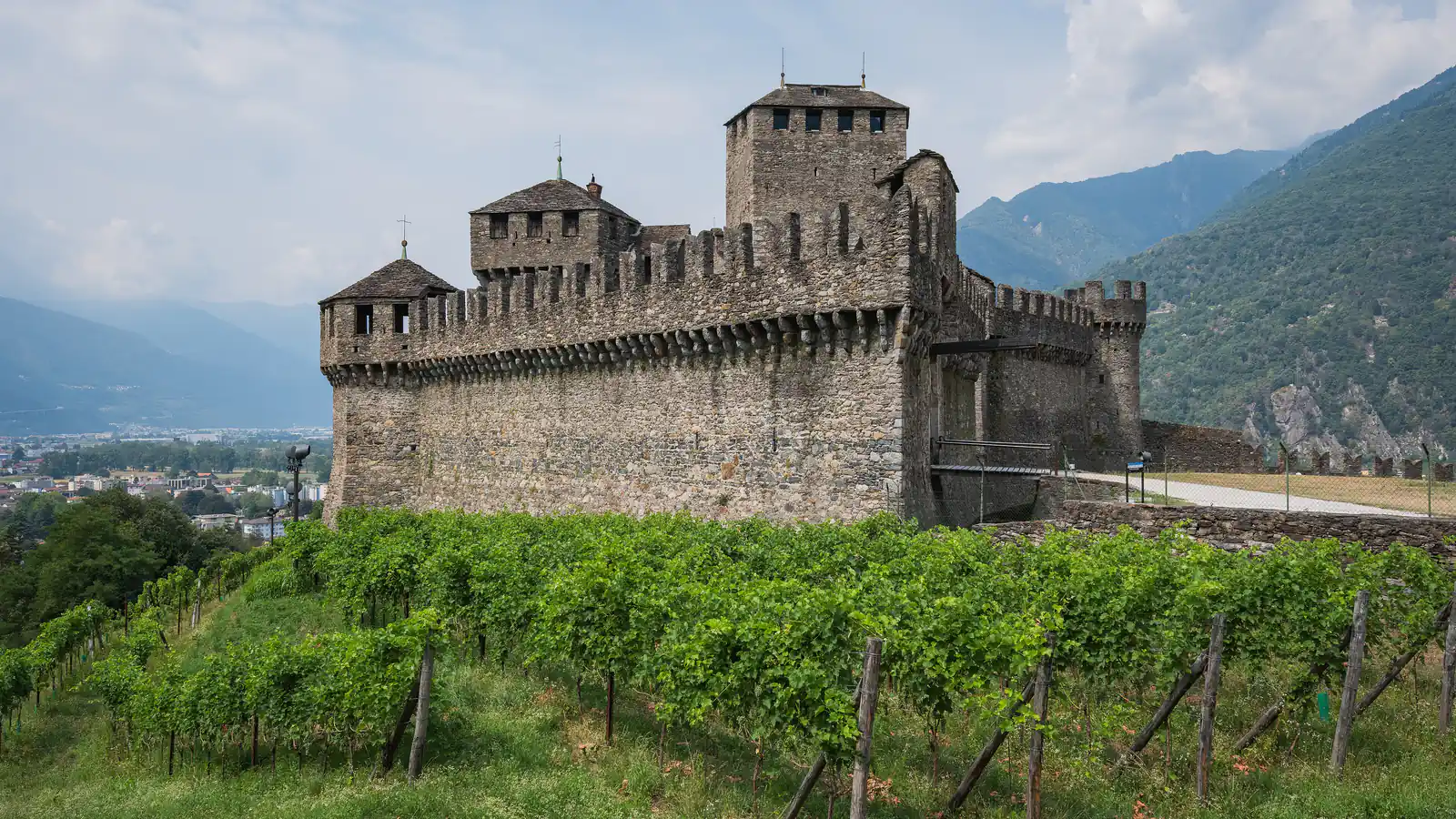
To choose a Ticino wine, start with a Merlot: it covers three-quarters of the canton's vineyards. Ticino, Switzerland's Italian-speaking canton, is the country's main wine region south of the Alps, with 1,115 hectares of vines in 2025 according to the Federal Office for Agriculture (FOAG), plus 28 hectares in the Mesolcina valley of Graubünden.
First planted in 1906, Merlot has become the canton's emblem. It makes mostly reds, but also a white Merlot pressed without the skins.
Where are the Ticino vineyards?
Ticino is Switzerland's southernmost canton, 45 kilometres from Milan. Ticinowine, the Ticino wine trade body, divides it into two areas on either side of Monte Ceneri: the Sopraceneri in the north, around Bellinzona and Locarno, and the Sottoceneri in the south, around Lugano and Mendrisio.
The vines grow between 220 and 700 metres above sea level on small, often very steep plots: a third of the area has a 30% slope, according to Ticinowine, which speaks of almost heroic winegrowing, typical of alpine areas.
In 2025, Italian-speaking Switzerland (Ticino and Mesolcina) lost 31 hectares, according to the FOAG, and its harvest fell by 8.1%, due to poor weather at flowering and harvest and the arrival of the Japanese beetle in the Mendrisiotto district.
Why does Merlot dominate in Ticino?
Merlot comes from Bordeaux. Ticinowine dates its first planting in Ticino to 1906; good trial results led the authorities and the main wineries to plant it widely. In 2025, according to the FOAG, it covers 833 hectares in Ticino, 75% of the canton's vines and 70% of all Swiss Merlot.
The climate explains its success. Swiss Wine Promotion, the body that promotes Swiss wine, describes plentiful rain and generous sunshine. Merlot has proved very versatile here, notes Ticinowine.
The same grape gives very different wines depending on the soil. In the north, Ticinowine describes moraine soils left by glaciers, stony and rich in sand and silt, which give austere wines built for ageing. In the south, between Lake Lugano and Chiasso, deep clay soils and a warmer climate give softer wines. Our Merlot page covers the grape in detail.
What else is worth tasting in Ticino?
Merlot bianco is a white wine made from red grapes: the bunches are pressed straight away, so the juice takes no colour from the skins. Swiss Wine Promotion notes that it is winning more and more fans.
Among white grapes, Chardonnay and Sauvignon Blanc are the most planted, according to the FOAG. Among reds, you will also find Cabernet Franc, Cabernet Sauvignon and Swiss crossings such as Gamaret and Divico.
The canton's rarity is Bondola, a native red grape. The FOAG counts only 7.6 hectares of it in Ticino. Since 2023 it has been a Slow Food Presidium, a programme that protects endangered traditional foods, according to Ticinowine.
What do DOC and VITI mean on a Ticino label?
DOC, denominazione di origine controllata, is the Italian name for the AOC. According to Ticinowine, the first Ticino DOC wines date from the 1997 vintage. Since 2010 the Ticino wine trade body has granted the right to use it, after tasting and analysing wines sampled from producers.
The VITI label is older. Introduced on 1 January 1948 to single out the best Merlots, it is awarded by a panel of experts after a tasting and a laboratory analysis. A VITI wine is always a red made from 100% Merlot.
Visiting and tasting in Ticino
Every spring, Cantine aperte, Ticino's open cellars, runs over two weekends: 15 and 16 May 2027 in the Sopraceneri and 22 and 23 May 2027 in the Sottoceneri, from 10am to 6pm, according to Ticinowine. It will be the 27th edition.
Bellinzona makes a good first stop: its three castles, such as Montebello in the photo at the top of this page, overlook vineyards. Ticinowine also tells how the Sopraceneri was once so covered in pergolas that a cat could have walked on them from Locarno to Giornico without touching the ground.
Ticino wine on Helvitic
Helvitic connects wineries and wine lovers directly, with no reseller in between. Sales are not open yet: payment is still being tested. Meanwhile you can browse the Ticino wineries already on Helvitic, save them as favourites and follow them to hear about new wines and events.
Once ordering opens, you will order in multiples of 6 bottles; every bottle will ship straight from the winery that made it, delivered to you or ready for pick-up at the cellar.
The vineyard in figures
Ticino and Mesolcina
Vineyard area
1,143.3 ha
Share of the Swiss vineyard
7.9 %
White and red
12% / 88%
Ticino and Mesolcina: the most planted grapes in 2025
Source: Federal Office for Agriculture (FOAG), «L’anno viticolo 2025», Statistiche vitivinicole, tables 1.2 and 1.3, as of November 2025. Hectares rounded to one decimal (published in ares). Shares calculated by Helvitic, first on the area of the region, then on the total Swiss vineyard area (14,431.0 ha). Read the statistics (PDF in Italian)
Key points
Switzerland's main wine region south of the Alps: 1,115 ha in Ticino in 2025.
Merlot, grown since 1906, covers 75% of the vines and also makes a white Merlot.
Two areas: Sopraceneri in the north (age-worthy wines), Sottoceneri in the south (softer wines).
DOC since the 1997 vintage; VITI label for the best Merlots since 1948.
A rarity: Bondola, 7.6 ha, a Slow Food Presidium since 2023.
Cantine aperte (open cellars) in May, over two weekends.
Red Merlot. It covers 75% of Ticino's vineyards in 2025 according to the FOAG, and the canton grows 70% of all Swiss Merlot.
Is there white wine from Ticino?
Yes, but not much: 12% of the area. The most distinctive is Merlot bianco, made from red grapes pressed without skin contact. Chardonnay and Sauvignon Blanc are also grown.
What does the VITI label guarantee?
Created in 1948, it marks 100% Merlot reds that have passed a laboratory analysis and a tasting by a panel of experts, according to Ticinowine.
When are the open cellar days in Ticino?
In May, over two weekends: in 2027, 15 and 16 May in the Sopraceneri and 22 and 23 May in the Sottoceneri, from 10am to 6pm.