
Serve Pinot Noir slightly cool with poultry, mushroom risotto or grilled lake fish: this supple red with strawberry, raspberry and cherry aromas stays light on the palate. It is the most planted grape in Switzerland, from the Valais to Graubünden. On Helvitic you will buy it straight from the wineries; orders open soon.
Swiss Pinot Noir
The country's most planted grape, from the Valais to Graubünden
On this page
What does Swiss Pinot Noir taste like?
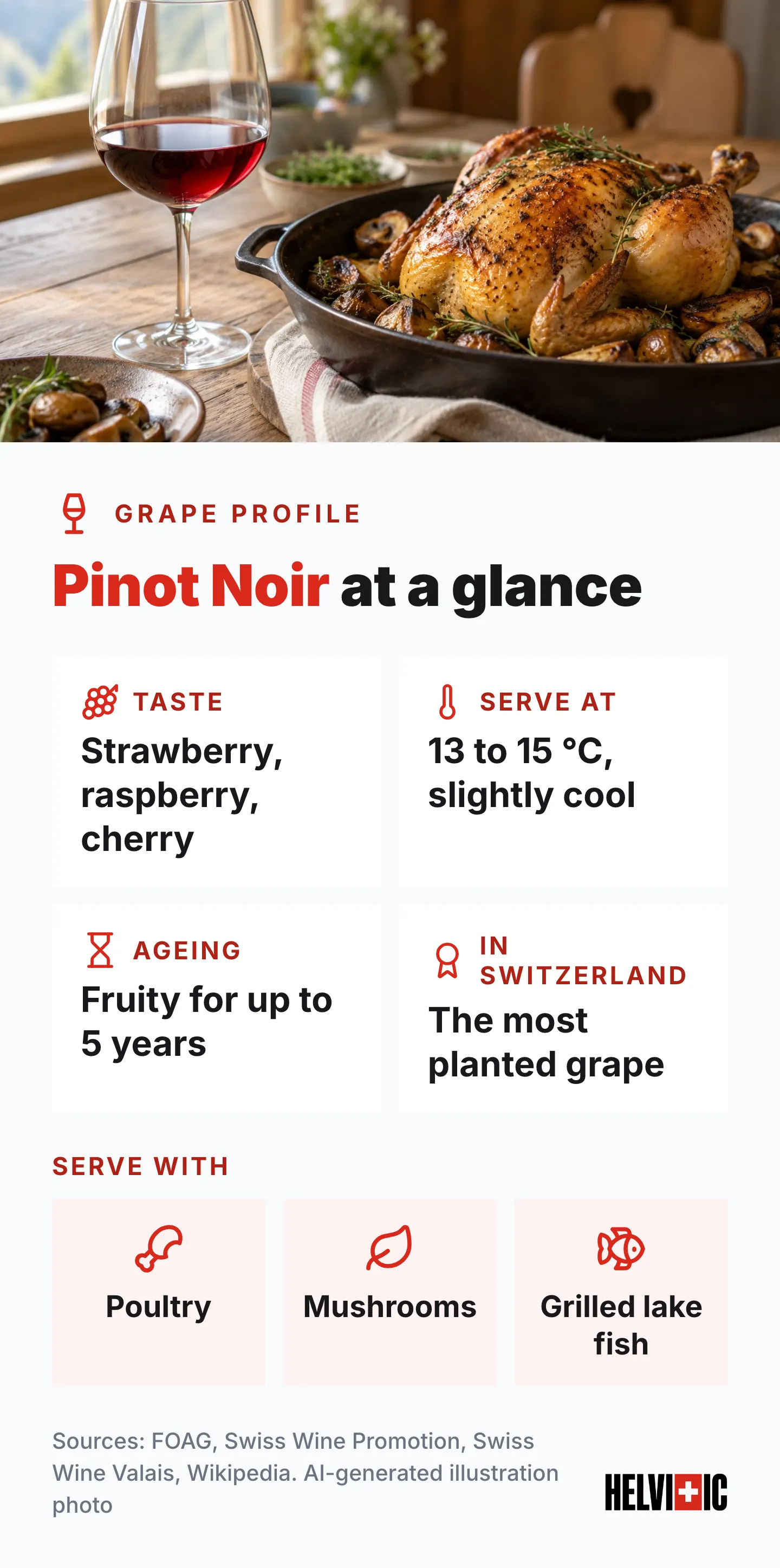
Young, it smells of red berries: strawberry, raspberry, cherry. Swiss Wine Promotion, the body that promotes Swiss wine, describes it as fresh and elegant, with gentle acidity and soft tannins. Tannins come from grape skins and seeds and leave a slightly drying feel in the mouth; in Pinot Noir they stay discreet.
With age, from about five years, it develops notes of wet leather, tobacco, autumn leaves and forest floor, especially after ageing in oak barrels. The colour deepens and the taste becomes richer.
Style depends on the region and the winery: light, fruity wines or powerful, complex cuvées. In Neuchâtel the same grape also makes a rosé, Oeil-de-Perdrix, which has its own page.
Where does Pinot Noir grow in Switzerland?
Everywhere. According to the Federal Office for Agriculture (FOAG), it is the most planted grape in the country, red and white combined, just ahead of Chasselas. About a third is in the Valais, followed by Vaud, Neuchâtel, Graubünden, Schaffhausen and Zurich. The charts on this page show the area by canton.
In the Bündner Herrschaft, the wine area of Graubünden around Fläsch, Maienfeld, Jenins and Malans, Swiss Wine Promotion calls it the dominant grape. The Schaffhausen wine area is nicknamed «Blauburgunderland», Pinot Noir country.
In the Valais, Swiss Wine Valais, the Valais wine trade body, notes that it was introduced around 1848 by the cantonal government to revive winegrowing. It does particularly well on the limestone soils of Salgesch and Sierre.
Blauburgunder, Dôle, Servagnin: what are its other names?
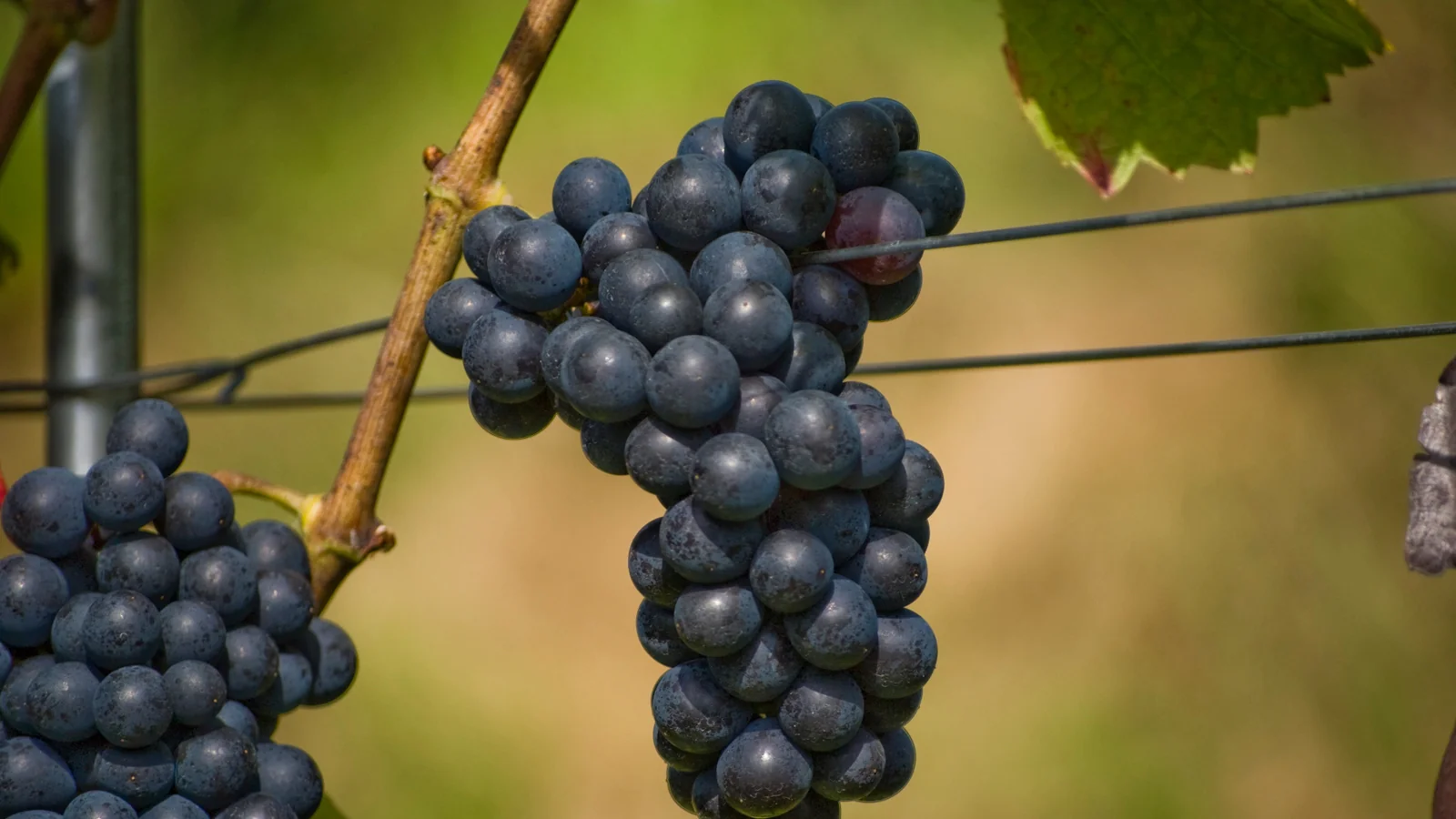
In German-speaking Switzerland it is called Blauburgunder; in Germany, Spätburgunder. The older name Clevner still turns up. The grape is the same. The word pinot is said to come from the pine cone, which the tight bunch resembles.
In Vaud it has been grown since the late 15th century, first under the name Servagnin, according to Swiss Wine Promotion. In the Valais it was called Dôle until 1942.
Today Dôle is no longer a grape but a Valais blend, a wine made from several grapes. According to Swiss Wine Valais, Pinot Noir and Gamay must together make up at least 51 %, with a majority of Pinot Noir; other reds such as Gamaret or Syrah can complete it.
What to eat with Pinot Noir?
Serve it with poultry, from chicken to duck, pork dishes or pasta in a cream sauce. Because of its lively fruit and delicate structure, Swiss Wine Promotion even suggests it with grilled lake fish or fish cooked en papillote, an unusual match for a red.
Its forest-floor notes suit risotto or a mushroom tart. Served slightly cool, it also goes with ratatouille or aged hard cheeses. For fondue chinoise (thin meat slices cooked in broth at the table), our French and German articles compare it with other Swiss reds.
How to serve it, and how long to keep it?
At 13 to 15 °C, according to Swiss Wine Promotion, a little below room temperature. Swiss Wine Valais adds that Pinot Noir can be served slightly cooler than Cornalin or Diolinoir, which are more structured reds. Served too warm, a red tastes heavy.
Between three and five years old, it shows mostly fruit. Cuvées aged in oak gain complexity after five years.
Vineyard area in Switzerland
Pinot Noir: official 2025 figures
- Area in Switzerland
- 3,594.3 ha
- Share of the Swiss vineyard
- 24.9 %
- Rank among red grapes
- 1st of 172
Key points
- Fresh, elegant red: strawberry, raspberry, cherry, then forest floor with age.
- The most planted grape in Switzerland according to the FOAG; about a third is in the Valais.
- Called Blauburgunder in German-speaking Switzerland; the main grape of Valais Dôle.
- Good with poultry, pork, mushrooms and even grilled lake fish.
- Serve at 13 to 15 °C; fruity up to five years, more complex after that if oak-aged.
- On Helvitic, orders open soon, straight from the wineries.
Frequently asked questions: Swiss Pinot Noir
What is the best Swiss Pinot Noir?
There is no single answer, because styles range from light and fruity to oak-aged wines for keeping. Start with a region: the Valais, Neuchâtel, the Bündner Herrschaft and Schaffhausen give different Pinots. Then compare two cuvées from the same winery, one aged in tank, the other in oak.
Is Swiss Pinot Noir a light red?
Mostly, yes: Swiss Wine Promotion describes it as fresh and elegant, with soft tannins. Oak-aged cuvées are more powerful and keep longer.
Is Blauburgunder the same as Pinot Noir?
Yes. Blauburgunder is the name used in German-speaking Switzerland for Pinot Noir. In Germany the same grape is called Spätburgunder.
Sources
- Federal Office for Agriculture (FOAG), «L’anno viticolo 2025», Statistiche vitivinicole, as of November 2025 (PDF)
- Swiss Wine Promotion, grape variety profile: Pinot Noir (taste, ageing, food pairings, Servagnin, 13 to 15 °C), checked on 21 October 2026
- Swiss Wine Promotion, Graubünden wine region (Bündner Herrschaft), checked on 21 October 2026
- Swiss Wine Promotion, Three Lakes wine region (Œil-de-Perdrix), checked on 21 October 2026
- Swiss Wine Valais, Pinot Noir (arrived in 1848, called Dôle until 1942), checked on 21 October 2026
- Swiss Wine Valais, Dôle (blending rules), checked on 21 October 2026
- Swiss Wine Valais, serving temperatures, checked on 21 October 2026
- Wikipedia (German), Pinot noir: Clevner, Blauburgunderland, checked on 21 October 2026
- Wikipedia (German), Blanc de Noirs: Federweisser in German-speaking Switzerland, checked on 21 October 2026