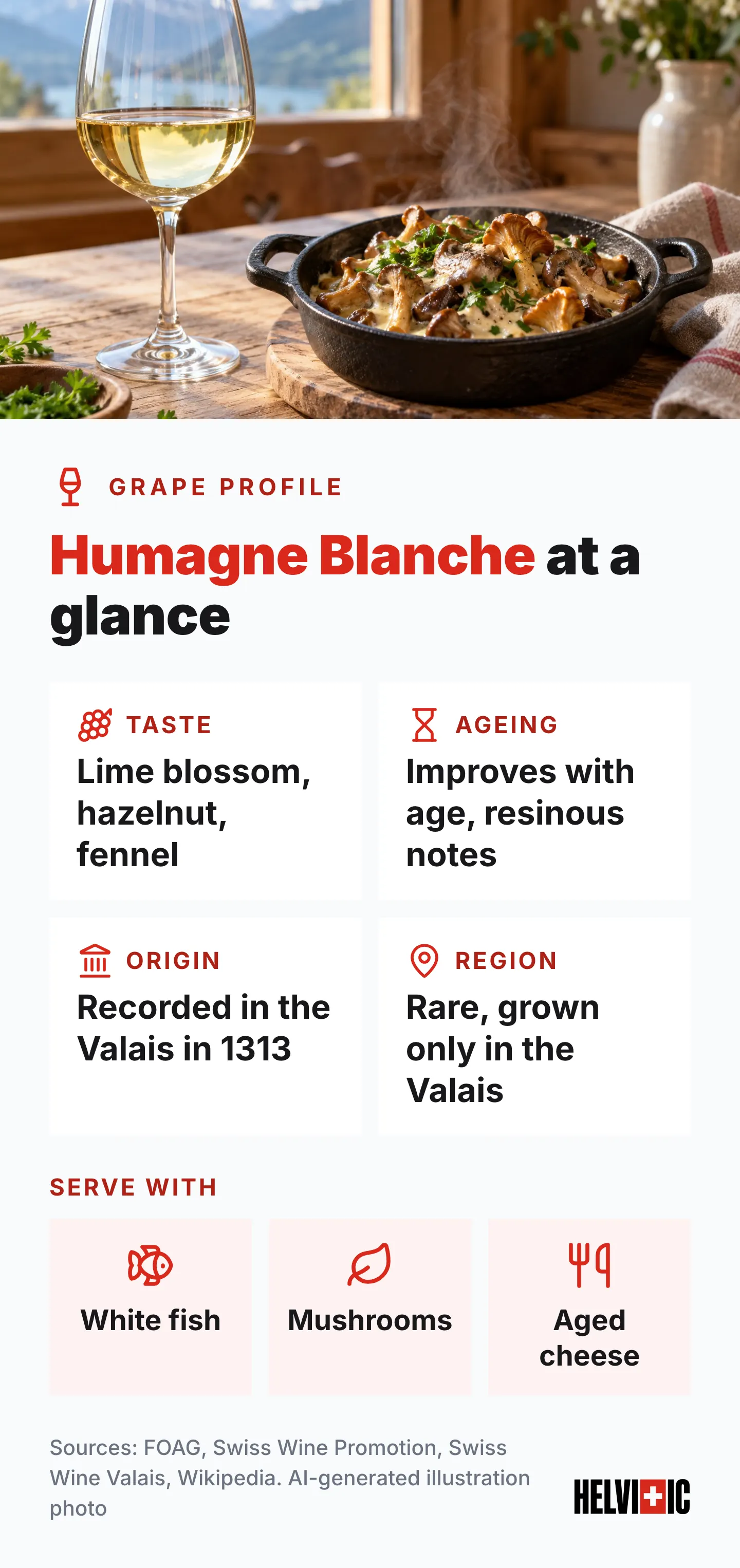
Serve a Humagne Blanche with white fish or a mushroom dish: this dry, delicate white smells of lime blossom and hazelnut, then turns resinous with age. Recorded in 1313, the grape grows only in the Valais, a canton in south-west Switzerland, and is unrelated to Humagne Rouge. On Helvitic you will buy it from the winery.
Orders are not open yet: online payment is still in its test phase. Once it opens, each winery sells its own bottles.
What does Humagne Blanche taste like?
Young, it is fairly neutral, lively and floral: Swiss Wine Valais, the trade body for Valais wines, mentions lime blossom and lily, with a hint of fennel on the finish. At that stage it resembles a young Fendant, the Valais name for Chasselas.
It opens up with time. Swiss Wine Promotion, the body that promotes Swiss wine, describes a delicate, elegant wine with lime blossom and hazelnut that turns resinous as it ages. It shows best as a dry wine. Among the Valais's other white specialities, Amigne, grown mainly in Vétroz, and Malvoisie, usually sweet, complete the range.
Only by name. Swiss Wine Promotion and Swiss Wine Valais both say Humagne Blanche has no genetic link to Humagne Rouge. It is not a white version of the same grape.
‘Humagne’ may come from the Greek hylomaneus, ‘luxuriant’, probably for the vigour of the vine. Our Humagne Rouge page covers the red Valais Humagne.
Where does Humagne Blanche come from?
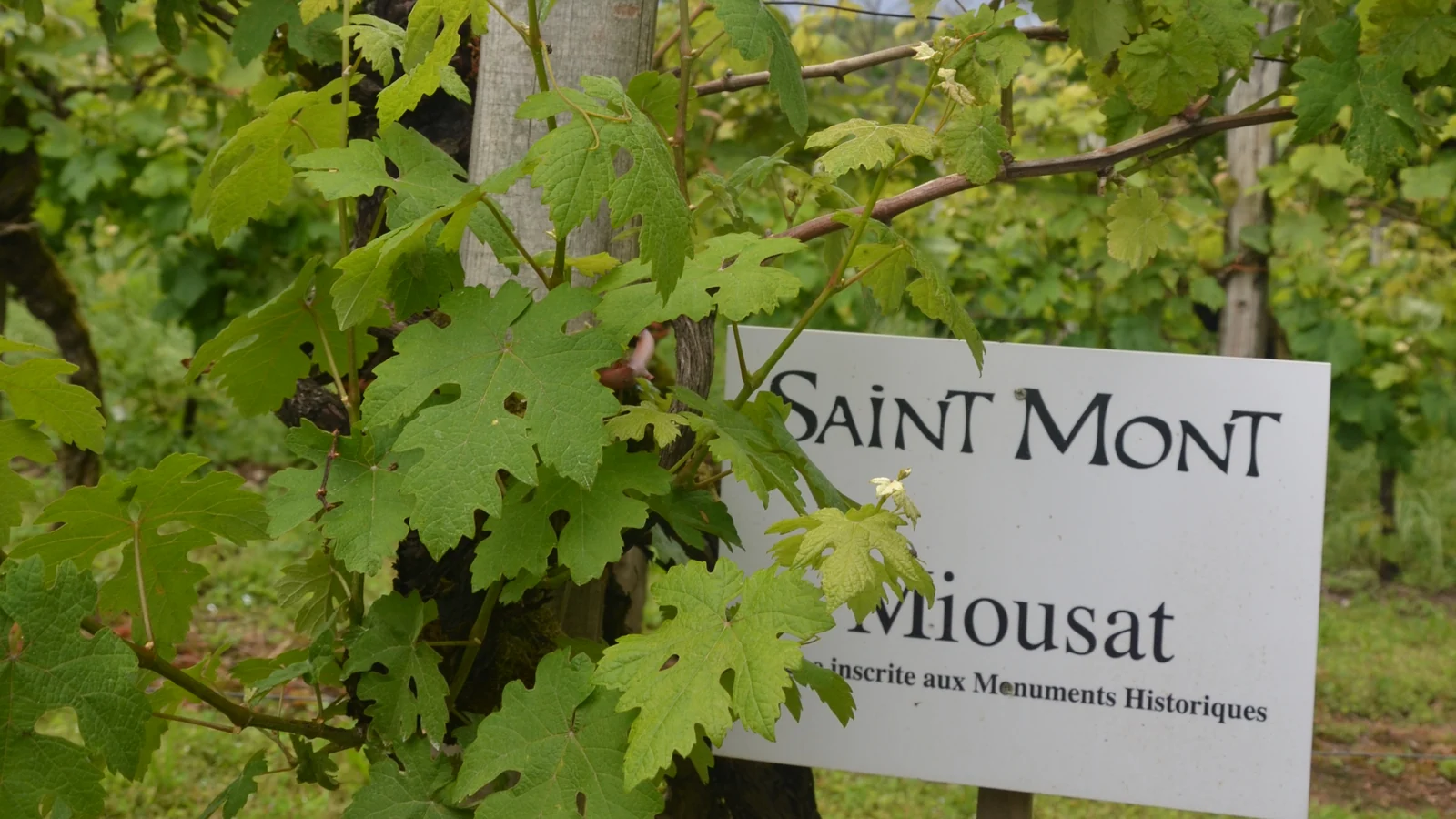
A parchment from 1313 mentions it in the Valais alongside Rèze, another old white Valais grape, making it one of Europe's oldest grapes, according to Swiss Wine Promotion. DNA tests show it is a parent of Lafnetscha and Himbertscha, two rare Valais grapes, and point to possible roots in the French Pyrenees, where it is called Miousat.
Late-ripening and vigorous, it was one of the most planted Valais grapes until the 19th century, then almost vanished in the early 20th. It is gaining ground again but remains rare: according to the Federal Office for Agriculture (FOAG), all Swiss Humagne Blanche grows in the Valais, on a handful of hectares.
Why is it called the ‘new mothers' wine’?
Around 1815 it was given that name because people thought it was rich in iron, Swiss Wine Valais reports; it was recommended to new mothers. The iron content was never proven. Wikipedia notes that giving a bottle of Humagne Blanche for a birth is still a custom in some places.
What food goes with Humagne Blanche, and should you age it?
Serve it with white fish such as sea bass, sea bream or perch fillets, with mushroom dishes or with aged hard cheese, as Swiss Wine Promotion suggests. Its finesse does not mask the fish, and its hazelnut notes suit mushrooms and cheese.
Keep a bottle for a few years: its acidity lets it age, and Swiss Wine Valais says it gains unexpected depth over time.