Serve an Amigne with foie gras, a shellfish bisque or a cheese dish: this white from the Valais, dry or sweet, smells of citrus, lime blossom and pear. It grows almost only in the Valais, mainly in the village of Vétroz, where bees on the label show how sweet it is. On Helvitic you will buy it from the winery.
Orders are not open yet: online payment is still in its test phase. Once it opens, each winery sells its own bottles.
What do the bees on the label mean?
They show the residual sugar, the grape sugar left in the wine after fermentation. According to Swiss Wine Promotion, the body that promotes Swiss wine, this label is reserved for Amigne de Vétroz.
One bee: under 8 grams of sugar per litre, a dry wine. Two bees: 9 to 25 g/l, an off-dry wine. Three bees: over 25 g/l, a sweet wine. Vétroz producers have used the system since the 2005 vintage.
Off-dry wines make up most of the production. Choose the number of bees to suit the dish: the sweeter the wine, the richer the food can be.
What does Amigne taste like?
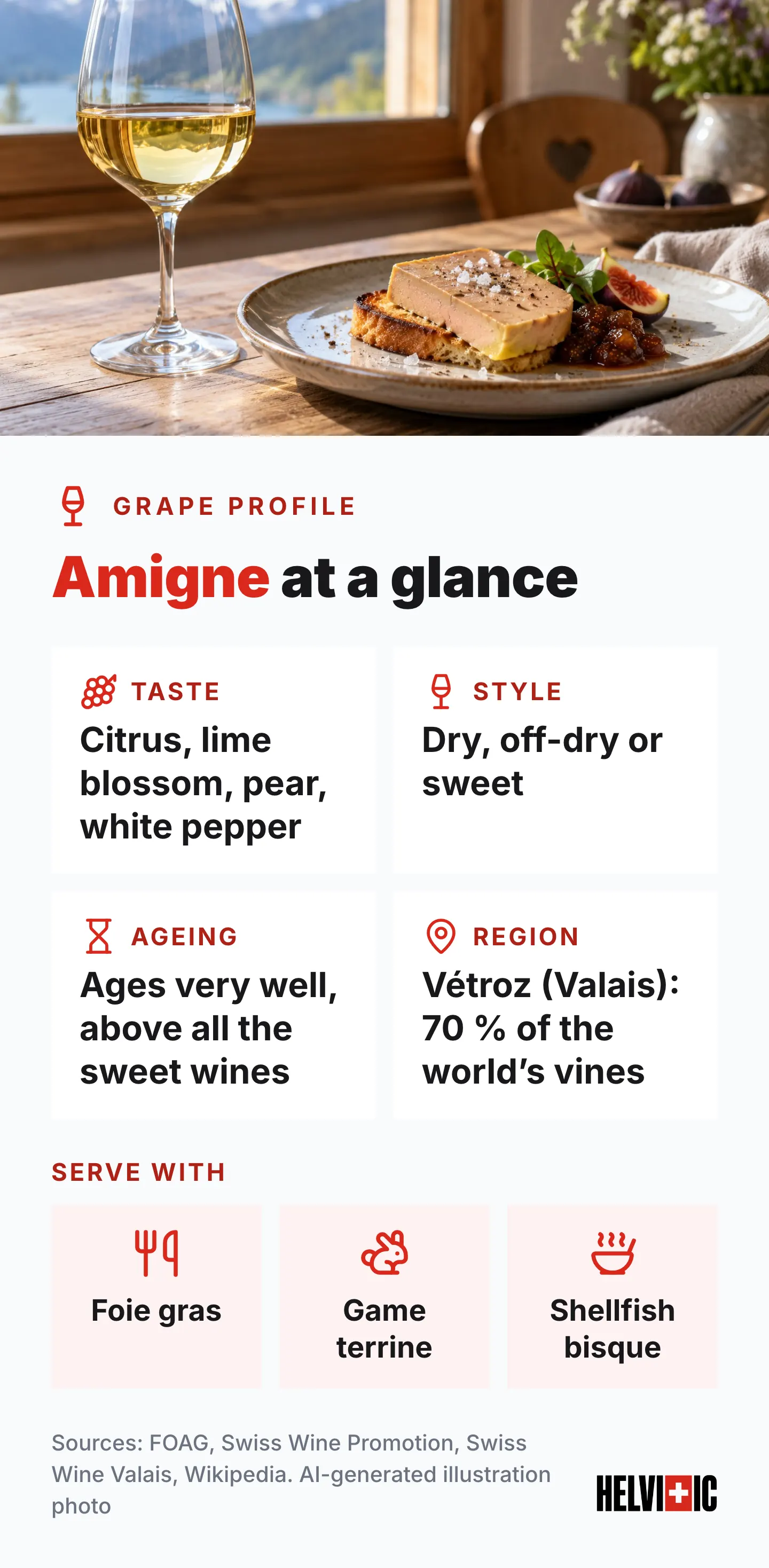
Dry or off-dry, it shows tea, lime blossom, pear, citrus and white pepper, with a slightly grippy palate and a gentle bitter finish, according to Swiss Wine Promotion. Swiss Wine Valais, the trade body for Valais wines, calls it generous and broad, with firm acidity.
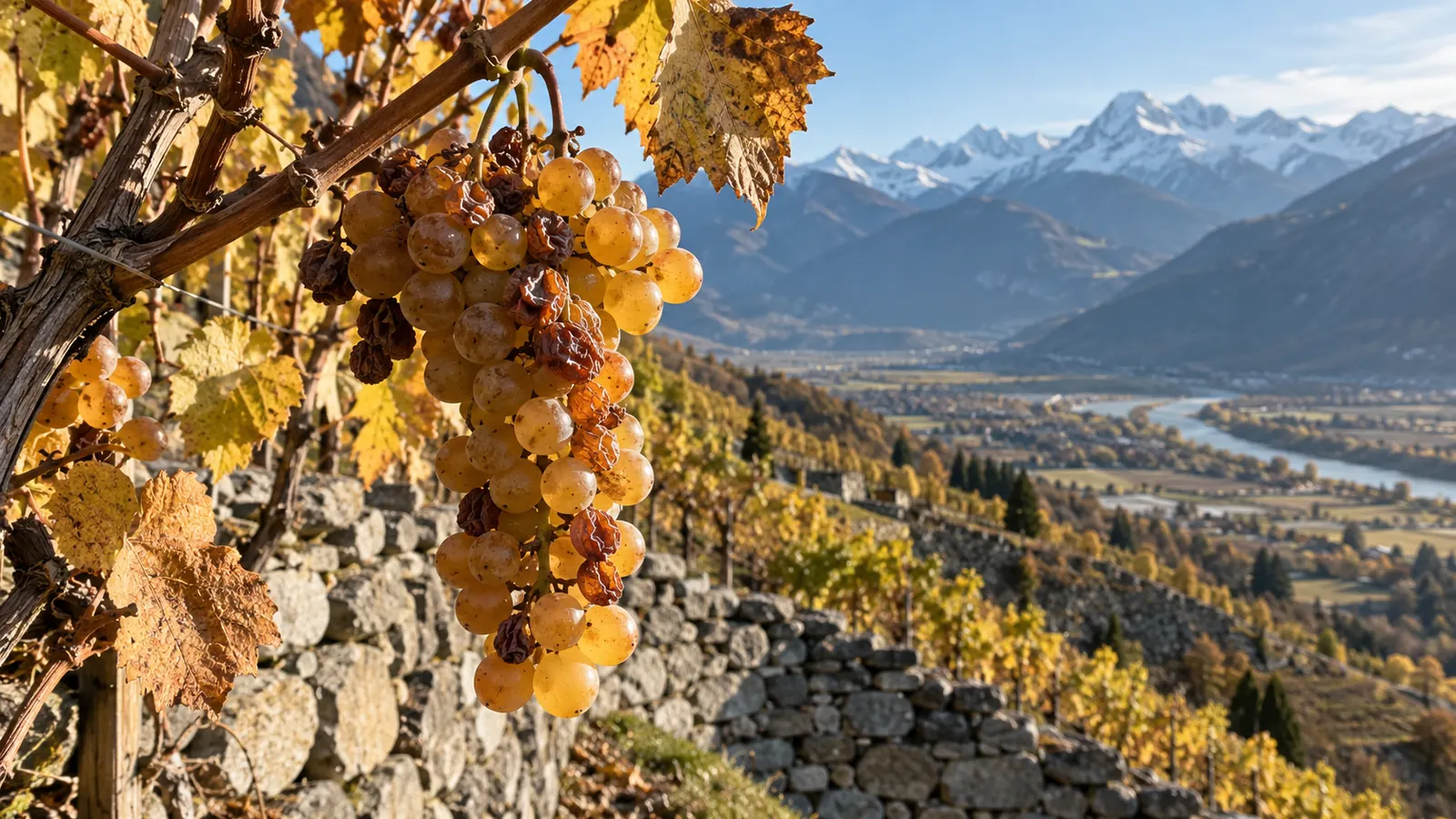
Sweet versions smell of orange and mandarin peel and dried apricot. It is a late-ripening grape with loose, airy bunches: they can hang on the vine for a long time, concentrating sugar in the autumn sun.
What food goes with Amigne?
Swiss Wine Promotion suggests foie gras, game terrine, shellfish bisque and cheese dishes. Its acidity and slight bitterness balance the fat in these foods; its sweetness, when it has some, matches their richness.
Why does Amigne grow in Vétroz?
A Valais grape, Amigne is recorded in the late 17th century between Sierre and Sion, then settles in Vétroz, which now has 70% of the world's Amigne vines, according to Swiss Wine Promotion. By the early 20th century it survived only in a few plots, mostly on that slope, Swiss Wine Valais notes.
Its parents are unknown. Savagnin Blanc, called Heida or Païen in the Valais, and Gouais Blanc may be its grandparents; the Roman origin sometimes claimed for it has no serious basis. According to the Federal Office for Agriculture (FOAG), almost all Swiss Amigne grows in the Valais.
How long can you keep Amigne?
A long time. Swiss Wine Valais credits it with one of the best ageing potentials, dry or sweet: after several decades, great vintages can be remarkable. Swiss Wine Promotion speaks of extraordinary ageing potential for sweet wines from grapes overripened on the vine.
Sweet wines may also be made under the Grain Noble ConfidenCiel quality charter, which Swiss Wine Promotion mentions. Our Malvoisie page covers the Valais's other great sweet white.
Vineyard area in Switzerland
The FOAG counts Amigne as planted area, without separating dry, medium-sweet and sweet wines.
Amigne: official 2025 figures
Area in Switzerland
39.1 ha
Share of the Swiss vineyard
0.3 %
Rank among white grapes
17th of 142
Amigne: area by canton
Canton
Area
Share of Swiss total
Valais
38.8 ha99.4 %
99.4 %
Vaud
0.2 ha0.4 %
0.4 %
Graubünden
0.1 ha0.1 %
0.1 %
Source: Federal Office for Agriculture (FOAG), «L’anno viticolo 2025», Statistiche vitivinicole, as of November 2025. Hectares rounded to one decimal (published in ares). Shares calculated by Helvitic, first on the total Swiss vineyard area (14,431.0 ha), then on the grape's Swiss area. Rank based on the FOAG list of grape varieties. Read the statistics (PDF in Italian)
AI-generated illustration photo
Key points
Valais white, dry, off-dry or sweet: citrus, lime blossom, pear, white pepper.
In Vétroz, one, two or three bees mean under 8 g/l, 9 to 25 g/l or over 25 g/l of sugar.
Vétroz has 70% of the world's Amigne vines.
Serve with foie gras, game terrine, bisque or cheese dishes.
Ages very well, especially the sweet wines.
On Helvitic you will buy direct from the winery once orders open.
Frequently asked questions: Amigne
Is a two-bee Amigne sweet?
Slightly. Two bees mean 9 to 25 grams of sugar per litre: an off-dry wine. It is the most common style.
Is Amigne always sweet?
No. It can be dry, off-dry or sweet. In Vétroz, the number of bees on the label tells you which.
How do you pronounce Amigne?
The French way: ah-MEEN-yuh, with a soft ‘gn’ as in ‘lasagne’.