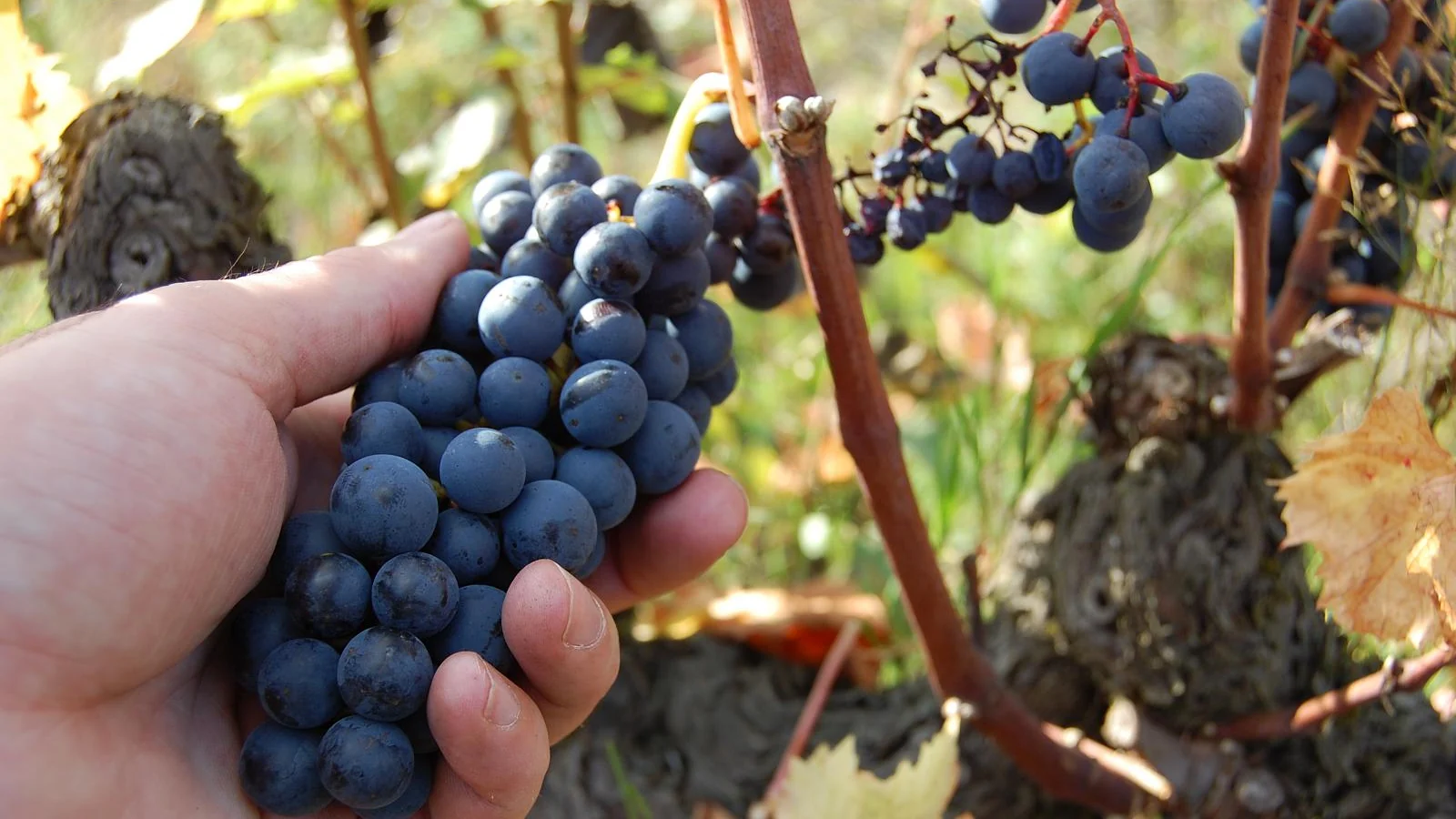
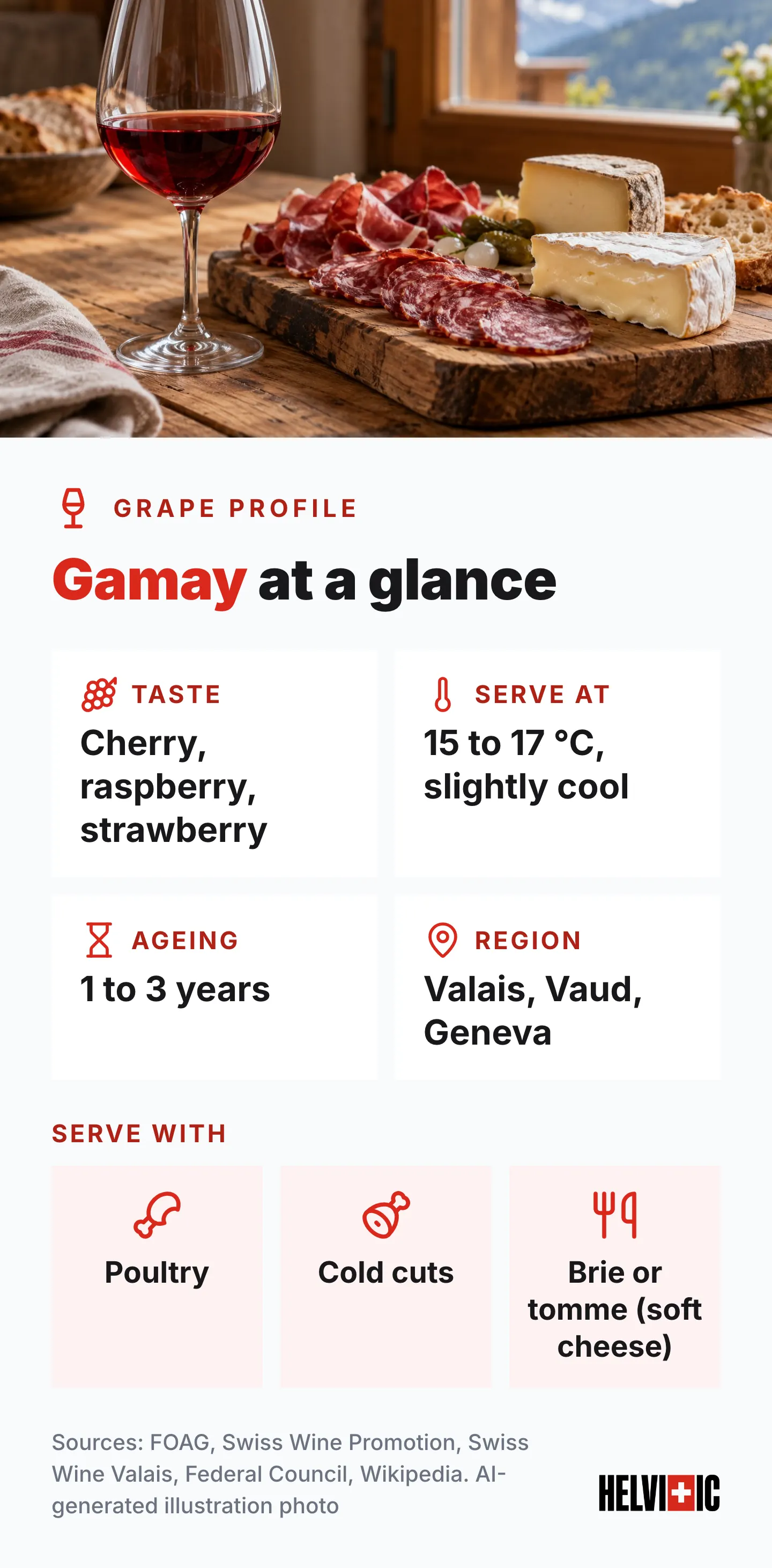
Serve a Gamay slightly cool with poultry, cold cuts or soft cheese: this light red smells of cherry, raspberry and strawberry and has few tannins. Switzerland's third red grape, it grows in the Valais, Vaud and Geneva, the French-speaking cantons in the west. On Helvitic you will buy it straight from the winery.
Orders are not open yet: online payment is still in its test phase. Once it opens, each winery sells its own bottles.
What does Gamay taste like?
Gamay makes fruity, light reds, loved for their freshness. Swiss Wine Promotion, the body that promotes Swiss wine, lists cherry, raspberry and strawberry, often with a touch of pepper or violet.
Its acidity is lively and its tannins are light, so it barely dries the mouth. Swiss Wine Valais, the trade body for Valais wines, describes a purple colour and a juicy, cheerful wine with bright fruit and no heaviness.
Gamay or Pinot Noir: what is the difference?
Gamay descends from Pinot Noir: DNA studies published in 1999 show it is a natural cross of Pinot Noir and Gouais Blanc. According to Swiss Wine Promotion, it often has a more floral nose, more pronounced minerality and slightly livelier acidity than the more elegant, more complex Pinot Noir.
Higher yields usually make it the cheaper bottle. The two grapes meet in Dôle, the Valais red blend of Pinot Noir and Gamay, and in Salvagnin, a red from Vaud. Our Pinot Noir page covers Dôle's other grape.
Where does Gamay grow in Switzerland?
Almost only in French-speaking Switzerland. According to the Federal Office for Agriculture (FOAG), it is the country's third red grape, and nearly all of it grows in the Valais, Vaud and Geneva. The charts on this page show the detail.
It came from Burgundy in the 19th century, when Swiss vineyards were replanted. It likes limestone and granite soils; Swiss Wine Valais links its reputation in the Lower Valais, between Fully and Martigny, to granite, as in the top Beaujolais villages. Back in Burgundy, Duke Philip the Bold had it pulled up in the Middle Ages, calling it a ‘vile and disloyal plant’.
What food goes with Gamay?
Keep the food simple. Swiss Wine Promotion suggests poultry, cold cuts, soft cheeses such as brie or tomme, mushrooms and quiches. With so few tannins it does not turn harsh next to cheese, and its acidity refreshes after fatty charcuterie.
Helvitic's mulled wine guide, in French and German, suggests it too: mulled wine needs a fruity, low-tannin red.
How cool should you serve Gamay, and how long does it keep?
Serve it at 15 to 17 °C, as Swiss Wine Promotion recommends: slightly cool, to keep the fruit. Take it out of the cellar or fridge a little before the meal rather than serving it at room temperature.
Drink it young: Gamay is usually at its best one to three years after bottling. Top-quality wines can keep five to ten years or more in good conditions.
Vineyard area in Switzerland
Gamay: official 2025 figures
Area in Switzerland
1,020.9 ha
Share of the Swiss vineyard
7.1 %
Rank among red grapes
3rd of 172
Gamay: area by canton
Canton
Area
Share of Swiss total
Valais
433.0 ha42.4 %
42.4 %
Vaud
310.8 ha30.4 %
30.4 %
Geneva
275.1 ha26.9 %
26.9 %
Fribourg
1.3 ha0.1 %
0.1 %
Bern
0.4 ha< 0.1 %
< 0.1 %
Neuchâtel
0.1 ha< 0.1 %
< 0.1 %
3 other cantons
0.1 ha< 0.1 %
< 0.1 %
Source: Federal Office for Agriculture (FOAG), «L’anno viticolo 2025», Statistiche vitivinicole, as of November 2025. Hectares rounded to one decimal (published in ares). Shares calculated by Helvitic, first on the total Swiss vineyard area (14,431.0 ha), then on the grape's Swiss area. Rank based on the FOAG list of grape varieties. Read the statistics (PDF in Italian)
AI-generated illustration photo
Key points
Light, fruity red: cherry, raspberry, strawberry, lively acidity, few tannins.
Switzerland's third red grape, almost only in the Valais, Vaud and Geneva.
A descendant of Pinot Noir, blended with it in Dôle and Salvagnin.
Serve with poultry, cold cuts, brie, tomme or mushrooms.
Serve at 15 to 17 °C and drink within one to three years.
On Helvitic you will buy direct from the winery once orders open.
Frequently asked questions: Gamay
What is Gamay wine?
Wine made from Gamay, a red grape from Burgundy. In Switzerland it makes light, fruity reds, mainly in the Valais, Vaud and Geneva.
Is Dôle the same as Gamay?
No. Gamay is a grape; Dôle is a Valais wine that blends Pinot Noir and Gamay.
Which cheese goes with Gamay?
Soft cheeses such as brie or tomme, according to Swiss Wine Promotion. Gamay's fresh fruit suits their mild taste.
Is there Gamay rosé?
Yes. Gamay is mostly made as a red, but also as rosé and even sparkling wine, according to Swiss Wine Promotion.