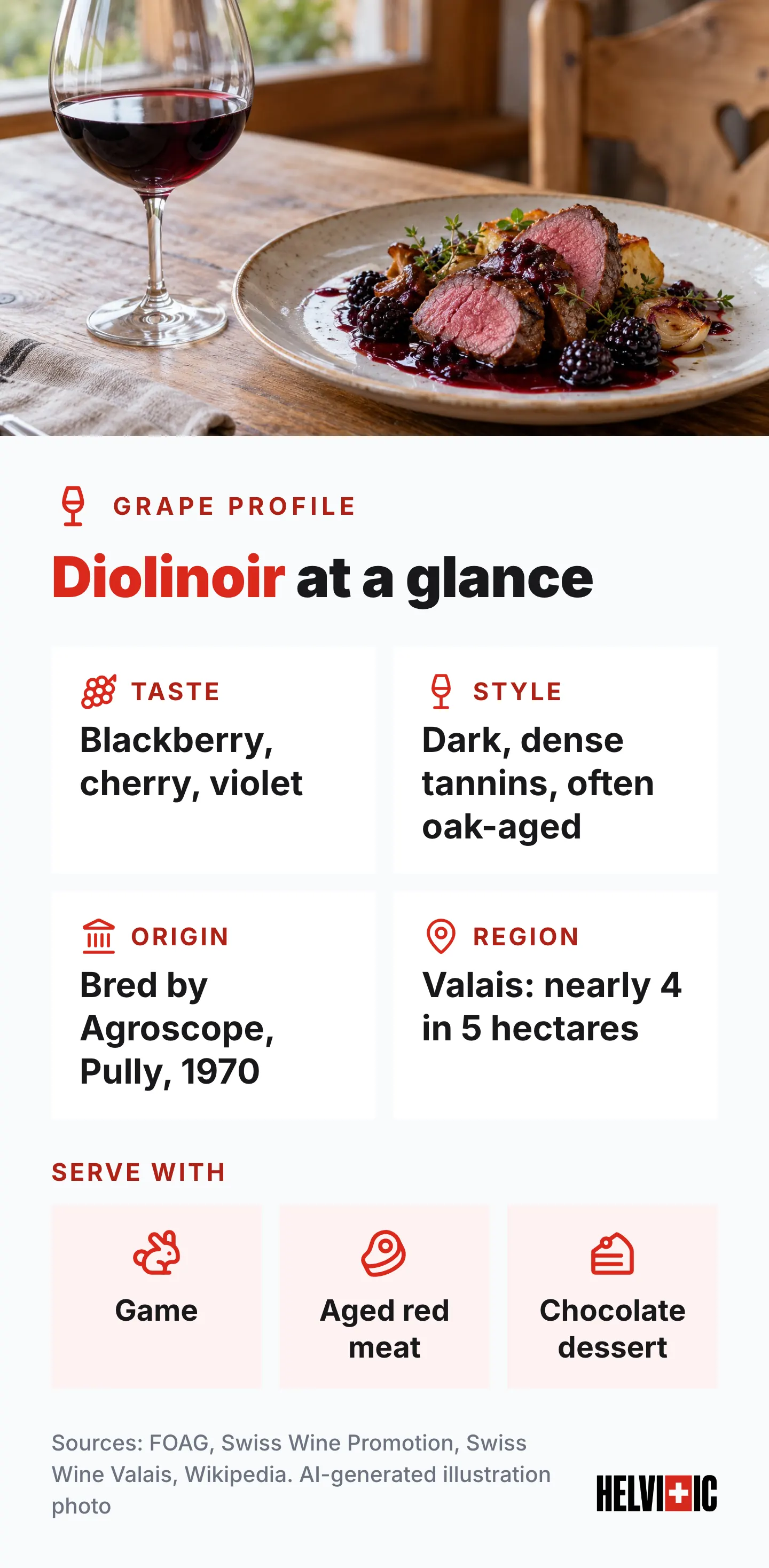
Choose a Diolinoir for game or red meat: this deep-coloured Swiss red, with dense tannins, smells of blackberry, cherry and violet. Bred in Pully in 1970, it grows mainly in the Valais, a canton in south-west Switzerland, and is often aged in oak. On Helvitic you will buy it straight from the winery.
Orders are not open yet: online payment is still in its test phase. Once it opens, each winery sells its own bottles.
What does Diolinoir taste like?
Swiss Wine Valais, the trade body for Valais wines, describes a richly coloured, full-bodied wine with dense tannins and aromas of cherry and black fruit. Swiss Wine Promotion, the body that promotes Swiss wine, notes blackberry and violet.
Tannins come from the grape skins and slightly dry the mouth; dense means plentiful and fine. Diolinoir is usually made on its own and aged in barrique, a small oak barrel, before bottling.
Where does the name Diolinoir come from?
From its two parents, according to Swiss Wine Promotion: Robin Noir, known in the Valais as Rouge de Diolly, and Pinot Noir. Agroscope, the Swiss federal agricultural research centre, crossed them in Pully in 1970.
The aim was a Pinot Noir with more colour. Robin Noir had come to the Valais on trial in the 1920s, Swiss Wine Valais notes. The breeder, André Jaquinet, also created Garanoir.
Where does Diolinoir grow?
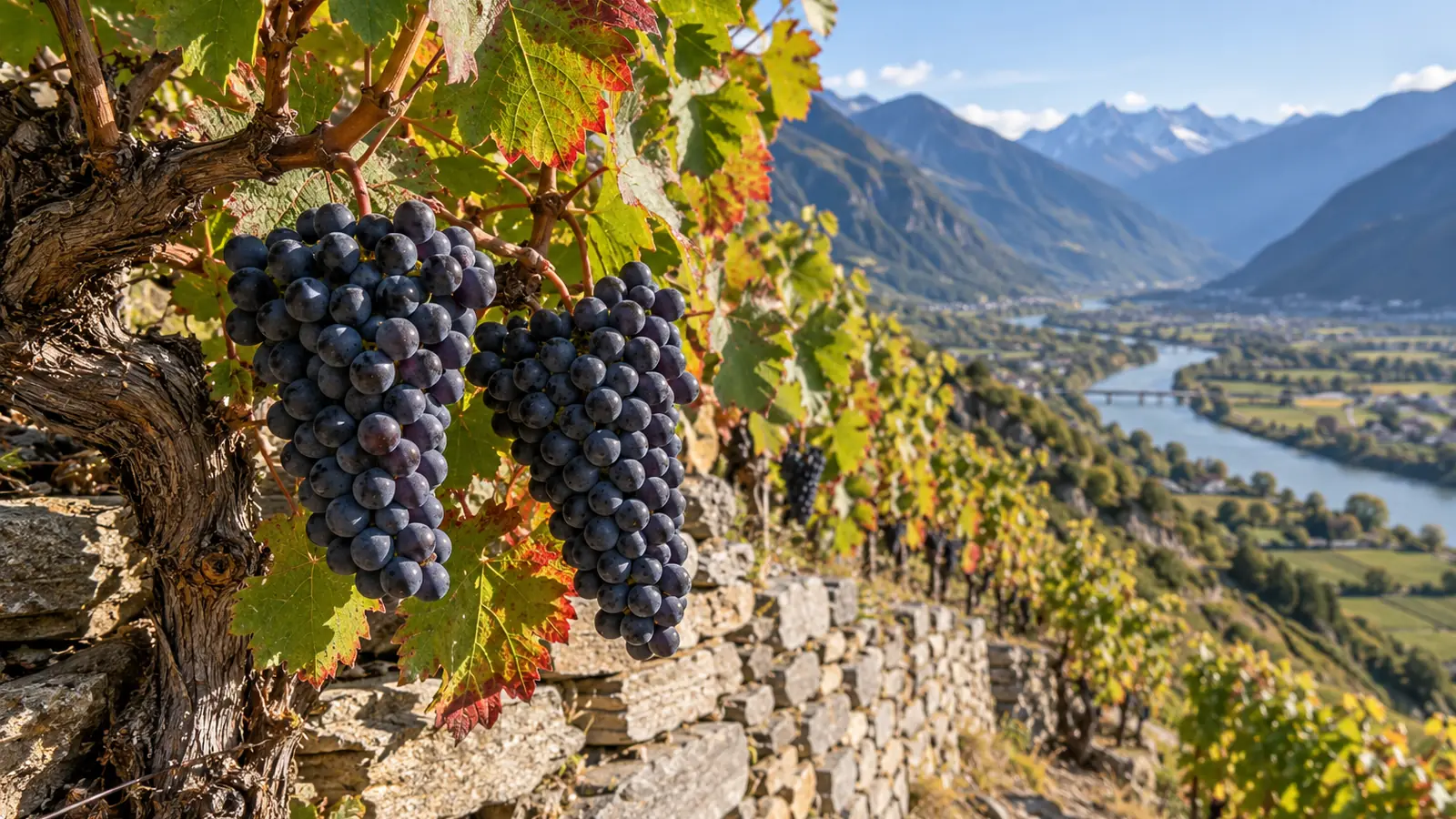
Mainly in the Valais: according to the Federal Office for Agriculture (FOAG), nearly four in five hectares of Diolinoir are there. Vaud has about a tenth, and a few hectares are spread across other cantons. The charts on this page show the detail.
Swiss Wine Valais describes it as moderately vigorous and disease-resistant; it ripens around the same time as most Pinot Noir and Gamay. Long planted to add colour to blends, it is more and more often made on its own.
What food goes with Diolinoir?
Serve it with venison, roe deer or wild boar, or with dry-aged red meat on the bone, as Swiss Wine Promotion suggests. Its dense tannins and dark fruit stand up to strongly flavoured meat.
For dessert it goes with rich chocolate dishes, red berries or candied fruit. Our pages on Syrah and Gamaret cover two other deep-coloured Swiss reds.