
Open a Cornalin with red meat, game or a slow-cooked stew: this dark red smells of black cherry and spice, with firm tannins and a slightly bitter finish. The old grape grows almost only in the Valais, a canton in south-western Switzerland. On Helvitic you will buy it straight from Valais wineries; orders open soon.
Cornalin from the Valais
The old «country red», saved just in time
On this page
What does Cornalin taste like?
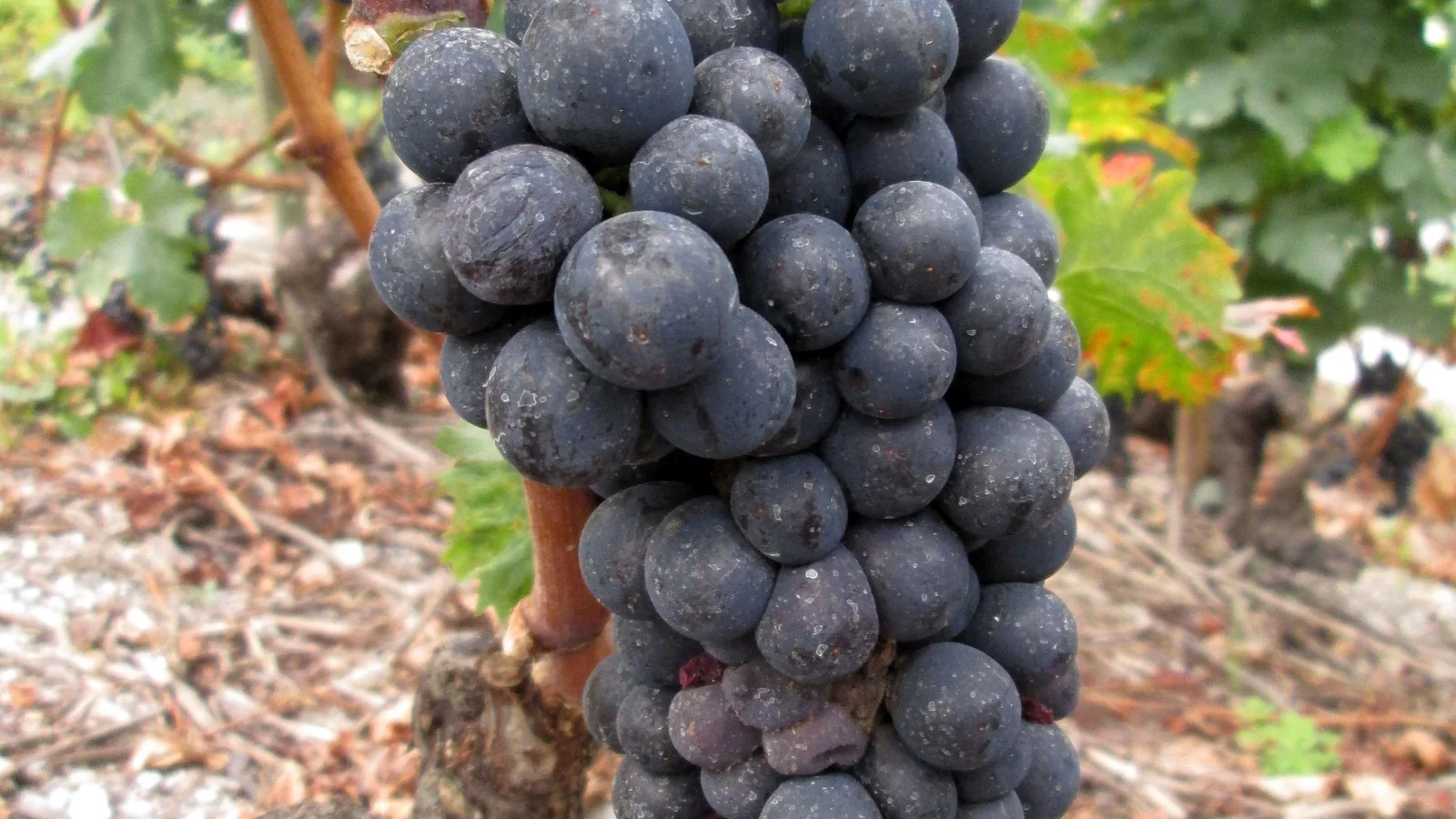
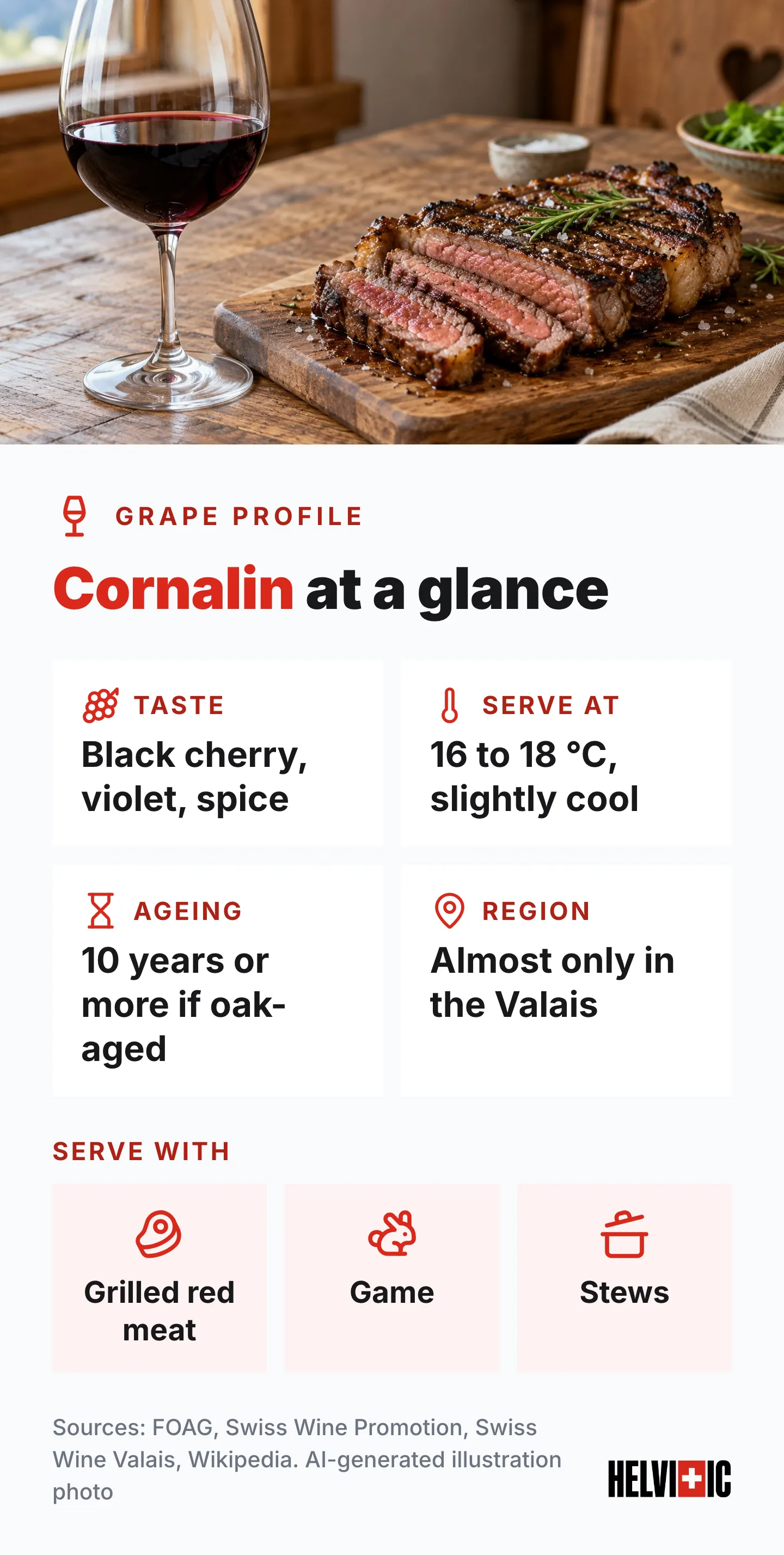
Expect a dark red colour with purple glints, then aromas of black cherry, violet, raspberry and spices such as clove. Swiss Wine Promotion, the body that promotes Swiss wine, describes dense, silky tannins and a pleasant touch of bitterness on the finish.
Tannins come from grape skins and seeds and leave a slightly drying feel in the mouth. In a young Cornalin they are firm; they soften with age, according to Swiss Wine Valais, the Valais wine trade body. Young, the wine is fruity and lively; with time it gains finesse.
Why is it also called «Rouge du Pays»?
Because that was its name. According to Swiss Wine Promotion, this old Valais grape was traditionally called Rouge du Pays, the country red, and was only renamed Cornalin in 1972, after a grape from the Aosta Valley. In German it is also known as Landroter, a name the federal statistics still use.
Its roots go deep. Cornalin is the first grape mentioned in a Valais document, the Anniviers register dated 20 January 1313. DNA tests show it is a natural cross of two Aosta Valley grapes, Petit Rouge and Mayolet. It probably reached the Valais over the Great St Bernard Pass, then vanished from its home valley.
It almost vanished from the Valais too. Temperamental, late-ripening and with irregular yields, it was nearly abandoned by the mid-20th century. A handful of growers revived it in the 1970s. Swiss Wine Valais now presents it as the oldest and most emblematic red of the canton.
Cornalin or Humagne Rouge: what is the difference?
They are two different grapes from the same family. Humagne Rouge arrived in the Valais in the late 19th century and was identified in 1999 as Cornalin d'Aoste. That Cornalin d'Aoste descends from the Valais Cornalin crossed with an unknown grape, according to Swiss Wine Promotion. So the Valais Cornalin is a parent of Humagne Rouge.
Hence the confusing names: Valais Cornalin is not Cornalin d'Aoste. In the glass, Humagne Rouge leans more towards forest floor, bark and violet, according to Swiss Wine Valais. It has its own page on Helvitic.
What to eat with Cornalin?
Serve it with grilled red meat or game such as wild boar, venison or roe deer: its tannic strength and its dark fruit and spice aromas stand up to these intense flavours, according to Swiss Wine Valais. Braised and slow-cooked dishes, such as boeuf bourguignon, suit it too.
Swiss Wine Promotion suggests simpler matches: lamb, grilled pork, roast chicken, pasta with tomato sauce, mildly spicy dishes, and even a cherry or chocolate dessert. For fondue chinoise (thin meat slices cooked in broth at the table), our French and German articles compare it with other Swiss reds.
How to serve and keep Cornalin?
Serve it at 16 to 18 °C, the range Swiss Wine Valais gives for full-bodied reds. It is served slightly warmer than a Pinot Noir because it has more structure.
Keeping time depends on the style. Cornalins aged in barrique, a small oak barrel, can keep ten years or more, according to Swiss Wine Valais, becoming rounder and deeper. Lighter versions made in steel tanks are best within five years, while the fruit is fresh.
The grape even has its own festival: Le Temps du Cornalin held its 20th edition in September 2026.
Vineyard area in Switzerland
Cornalin: official 2025 figures
- Area in Switzerland
- 166.5 ha
- Share of the Swiss vineyard
- 1.2 %
- Rank among red grapes
- 7th of 172
Key points
- Dark red: black cherry, violet, spice, dense tannins, slightly bitter finish.
- Formerly Rouge du Pays, renamed Cornalin in 1972; recorded in the Valais in 1313.
- Saved from extinction in the 1970s; grows almost only in the Valais.
- A parent of Humagne Rouge, but not the same as Cornalin d'Aoste.
- With red meat, game and stews; serve at 16 to 18 °C.
- On Helvitic, orders open soon, straight from Valais wineries.
Frequently asked questions: Cornalin
Is Cornalin a Swiss grape?
It has been in the Valais since at least 1313, but its parents come from the neighbouring Aosta Valley in Italy. As it disappeared there, it is now grown almost only in the Valais, which holds nearly all the area according to the FOAG.
Is Cornalin a full-bodied wine?
Fairly, yes: it has dense tannins and good structure. Versions made in steel tanks stay fruity and are good young; barrique-aged ones need a few years in the cellar.
Why is Cornalin rare?
Because it is hard to grow, ripens late and gives irregular yields, and because it grows almost only in the Valais. According to the Federal Office for Agriculture (FOAG), it is the seventh red grape in Switzerland.
Sources
- Federal Office for Agriculture (FOAG), «L’anno viticolo 2025», Statistiche vitivinicole, as of November 2025 (PDF)
- Swiss Wine Promotion, grape variety profile: Cornalin (Rouge du Pays, 1972, DNA, 1970s, food pairings), checked on 21 October 2026
- Swiss Wine Promotion, grape variety profile: Humagne Rouge (identified in 1999 as Cornalin d'Aoste), checked on 21 October 2026
- Swiss Wine Valais, Cornalin (taste, history, Temps du Cornalin), checked on 21 October 2026
- Swiss Wine Valais, Cornalin (ageing, food and wine pairings), checked on 21 October 2026
- Swiss Wine Valais, Humagne Rouge (aromatic profile), checked on 21 October 2026
- Swiss Wine Valais, serving temperatures, checked on 21 October 2026
- Wikipedia (French), Cornalin: Anniviers register, 20 January 1313, checked on 21 October 2026