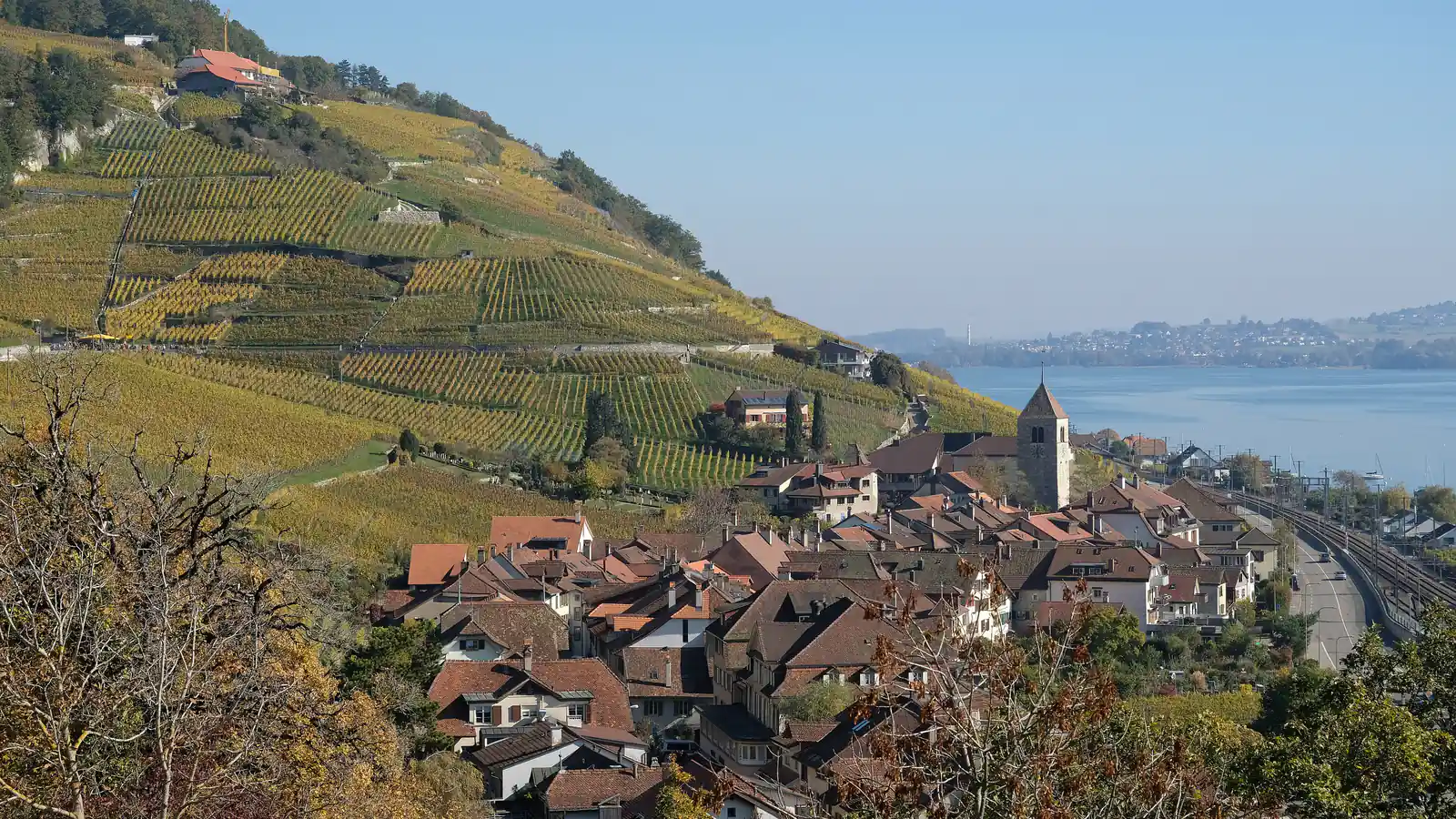
To taste Neuchâtel wine, start with an Œil-de-Perdrix, a Pinot Noir rosé born in the canton, or an unfiltered Chasselas, cloudy and lively. The Three Lakes region brings together Neuchâtel, the Bernese shore of Lake Biel, Vully and the Jura: 958 hectares of vines in 2025 according to the Federal Office for Agriculture (FOAG).
Pinot Noir covers almost half of the vines. And Neuchâtel is the Swiss canton where organic farming weighs most: two-thirds of its vineyard in 2025.
Where is the Three Lakes region?
It runs along the foot of the Jura mountains, beside three lakes. According to Swiss Wine Promotion, the body that promotes Swiss wine, it has three parts: Neuchâtel, on the north shore of the lake of the same name; Lake Biel, on the Bernese side, with the villages of Twann, Ligerz and La Neuveville; and Vully, between the lakes of Morat and Neuchâtel.
FOAG figures give Neuchâtel 603 hectares, the Lake Biel shore 220, Fribourg 117 (Fribourg Vully and Cheyres) and the Jura 18. The Vaud side of Vully, across the cantonal border, is counted with Vaud. Swiss Wine Promotion lists four AOCs in the region: Neuchâtel, Lac de Bienne (Bielersee), Vully and Cheyres.
Why does Pinot Noir do so well here?
Neuchâtel Vins et Terroir, the canton's wine body, describes a climate softened by the lake, milder in winter and during heatwaves, and vineyards backed by the Jura, sheltered from damp Atlantic air. Facing east, the slopes are well ventilated and sunny.
Soils at the foot of the first Jura ridge date from the Jurassic period: stony and light, sometimes marly, nearly always limestone. Neuchâtel Vins et Terroir sees these stony limestone soils as ideal ground for Pinot Noir. It covers 46% of the region's vines according to the FOAG, and 55% in Neuchâtel according to the wine body.
Among whites, Chasselas remains the main grape, followed by Pinot Gris and Chardonnay. Neuchâtel allows only twelve grape varieties under its AOC, to keep its wines typical, says Neuchâtel Vins et Terroir. Our pages on Pinot Noir, Œil-de-Perdrix and Chasselas cover these wines in detail.
What are Œil-de-Perdrix and Non filtré?
Œil-de-Perdrix (partridge eye) is a Pinot Noir rosé made with a short maceration: the juice stays on the skins only briefly, just long enough to take on a pale colour. According to Neuchâtel Vins et Terroir, its first official trace dates from 1861, a label printed by Louis Bovet, who made and sold wine in Areuse; locals call it “the Original”.
Non filtré is a Chasselas bottled without filtration. Fine lees, meaning dead yeast cells left in suspension, make it cloudy and bring notes of tropical fruit, according to the wine body.
Why is so much Neuchâtel wine organic?
In 2025, 416 hectares of Neuchâtel vines were farmed organically, 67% of the canton's vineyard, according to Federal Statistical Office data published by Bio Suisse, the Swiss organic farmers' federation. Neuchâtel leads, ahead of Jura and Fribourg; the Swiss average is 21.5%.
A Neuchâtel wine therefore has a good chance of being certified organic. On Helvitic, the certification appears on each wine page as declared by the winery; our organic wine page explains what the labels guarantee.
How long have vines grown in Neuchâtel?
Vines have been part of the Neuchâtel lakeshore for two thousand years, probably since Roman times. It was monks, however, who developed winegrowing: when it was founded in 998, the priory of Bevaix was allowed to plant a first vineyard, recalls Neuchâtel Vins et Terroir.
The area has risen and fallen. It exceeded 1,200 hectares in 1884, fell to 560 hectares in the early 1970s and has since settled at around 600 hectares.
Visiting and tasting around the three lakes
On the north shore of Lake Biel, a vineyard trail links Twann and Ligerz in about an hour, with panels on the history of winegrowing, according to Switzerland Tourism. At the end, the Rebbaumuseum Hof Ligerz, a wine museum, offers tastings for groups.
In Vully, the cellars sit in stone villages at the foot of Mont Vully; the Vully winegrowers' association describes vines growing on banks of molasse, a sandy rock. This is the home of Freiburger, a rare white grape: the FOAG counts fewer than 8 hectares in Switzerland, more than half of them in the canton of Fribourg.
Neuchâtel wine on Helvitic
Helvitic connects wineries and wine lovers directly, with no reseller in between. Sales are not open yet: payment is still being tested. Meanwhile you can browse the Three Lakes wineries already on Helvitic, save them as favourites and follow them to hear about new wines and events.
Once ordering opens, you will order in multiples of 6 bottles; every bottle will ship straight from the winery that made it, delivered to you or ready for pick-up at the cellar.
The vineyard in figures
Neuchâtel, Lake Biel, Fribourg and Jura
Vineyard area
958.0 ha
Share of the Swiss vineyard
6.6 %
White and red
43% / 57%
Neuchâtel, Lake Biel, Fribourg and Jura: the most planted grapes in 2025
Source: Federal Office for Agriculture (FOAG), «L’anno viticolo 2025», Statistiche vitivinicole, tables 1.2 and 1.3, as of November 2025. Hectares rounded to one decimal (published in ares). Shares calculated by Helvitic, first on the area of the region, then on the total Swiss vineyard area (14,431.0 ha). Read the statistics (PDF in Italian)
Key points
958 ha in 2025: Neuchâtel, Lake Biel, Vully and Jura, 7% of Swiss vineyards.
Jura limestone and a lake-softened climate: Pinot Noir on almost half of the area.
Œil-de-Perdrix, a Pinot Noir rosé, is documented in Neuchâtel since 1861.
Non filtré is a cloudy Chasselas bottled with its fine lees.
67% of Neuchâtel's vines are organic, the highest share in Switzerland, ahead of Jura and Fribourg.
Four AOCs: Neuchâtel, Lac de Bienne (Bielersee), Vully, Cheyres.
A Pinot Noir: it covers 55% of Neuchâtel's vineyard according to the local wine body. The limestone soils at the foot of the Jura give fine wines, which some wineries age in oak barrels.
What is Œil-de-Perdrix?
A Pinot Noir rosé whose juice stays only briefly on the skins. Neuchâtel claims it as its own: the first known label dates from 1861, printed by Louis Bovet in Areuse.
Why is unfiltered Chasselas cloudy?
Because it is bottled without filtration: fine lees, yeast cells in suspension, stay in the wine. They give it a hazy look and notes of tropical fruit.
Are Neuchâtel wines often organic?
Yes: in 2025, 67% of Neuchâtel's vineyard was farmed organically, according to Federal Statistical Office data published by Bio Suisse. That is the highest share in Switzerland, ahead of Jura and Fribourg.