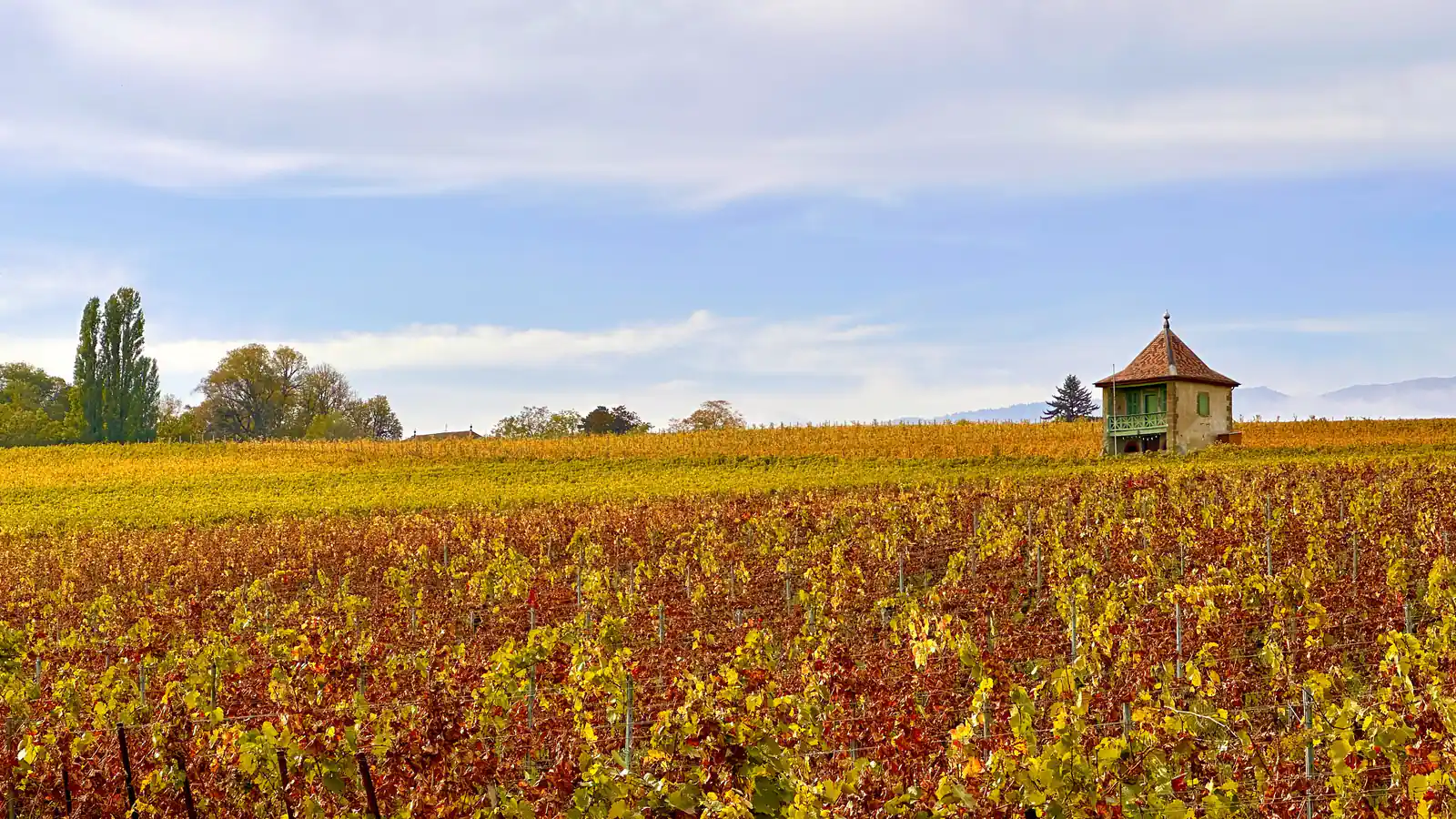
To taste Geneva wine, start with a Gamay: it is the canton's most planted grape, which happens nowhere else in Switzerland. Geneva is the country's third-largest wine canton, with 1,361 hectares of vines in 2025 according to the Federal Office for Agriculture (FOAG), some of them almost at the city limits.
It is also one of the few Swiss wine regions that is growing: 35 hectares more than in 2024, according to the same statistics. Satigny, in the Mandement area, is the largest wine-growing commune in Switzerland.
Where are Geneva's vineyards?
The vines sit between the Jura ridges and the cliffs of the Salève. Genève Terroir, the portal for Geneva's farm produce, divides them into three areas. The right bank, about 790 hectares, includes the Mandement with Satigny and Dardagny, plus Céligny and Collex-Bossy.
Between the Arve and the Rhône, about 270 hectares, lie Bernex, Lully, Confignon, Soral and Laconnex. Between the Arve and the lake, about 283 hectares stretch from Cologny to Hermance, including Meinier, Choulex and Jussy.
The FOAG notes that Geneva's 1,361 hectares include 115 hectares in the border zone. Winegrowing here is old: Genève Terroir traces it back without interruption to Roman times. In the 18th century the vineyard covered more than 2,000 hectares, before it shrank under competition from French wines brought in by rail and then phylloxera, an insect pest that devastated Europe's vineyards.
Which grapes make Geneva wine?
Red slightly leads: 56% of the area, according to the FOAG. Gamay comes first with 275 hectares, ahead of Chasselas (255 ha), Pinot Noir (160 ha), Gamaret (117 ha) and Chardonnay (116 ha). Gamay makes fruity, supple reds to drink young and slightly cool; Gamaret, a Swiss crossing, adds colour and tannin to blends.
Geneva also grows grapes rarely seen elsewhere in Switzerland. FOAG figures show the canton holds 90% of Swiss Aligoté, more than a quarter of the Chardonnay and a third of the Pinot Blanc. Aligoté, a white grape from Burgundy, reached Geneva around 1940 under the name Plant du Rhin, says Genève Terroir. Sauvignon Blanc does particularly well in the Mandement, around Satigny and Dardagny.
In Geneva, Chasselas is often sold as Perlan. Our pages on Gamay, Gamaret, Chasselas and Pinot Noir cover these grapes.
What do AOC Genève and the Premiers Crus guarantee?
Geneva wines have carried a protected designation of origin (AOC, appellation d'origine contrôlée) since 1988, according to Genève Terroir, making the canton one of the first in Switzerland to adopt it. The AOC guarantees that the grapes come from a defined area of the canton and follow rules on varieties, yields and sugar content.
Above AOC Genève, Swiss Wine Promotion, the body that promotes Swiss wine, lists 22 Premier Cru appellations tied to specific sites. The GRTA label (Genève Région Terre Avenir) also certifies local produce based on four principles: quality, proximity, traceability and fairness.
Which wine villages are worth a visit?
Satigny is the obvious first stop: many wineries open their tasting rooms there, and hamlets such as Bourdigny, in the photo at the top of this page, are surrounded by vines. Dardagny and Russin extend the Mandement towards the French border.
On the left bank, the slopes of Jussy, Choulex and Hermance look out over the lake and the Jura; between the Arve and the Rhône, Lully and Soral face the Salève. Swiss Wine Promotion highlights the patchwork of microclimates created by the Jura, the pre-Alps, the lake and the Rhône.
Where can you taste Geneva wine?
The event of the year is the Geneva Open Cellars (Caves ouvertes), organised by the canton's winegrowers. The 40th edition takes place on Saturday 22 May 2027, according to Genève Terroir, with the 2026 vintage and barrel-aged 2025 wines. It is a good day to move from village to village and compare the three areas.
The rest of the year, many wineries welcome visitors by appointment; Genève Terroir keeps a calendar of local food and wine events.
Geneva wine on Helvitic
Helvitic connects wineries and wine lovers directly, with no reseller in between. Sales are not open yet: payment is still being tested. Meanwhile you can browse the Geneva wineries already on Helvitic, save them as favourites and follow them to hear about new wines and events.
Once ordering opens, you will order in multiples of 6 bottles; every bottle will ship straight from the winery that made it, delivered to you or ready for pick-up at the cellar.
Source: Federal Office for Agriculture (FOAG), «L’anno viticolo 2025», Statistiche vitivinicole, tables 1.2 and 1.3, as of November 2025. Hectares rounded to one decimal (published in ares). Shares calculated by Helvitic, first on the area of the region, then on the total Swiss vineyard area (14,431.0 ha). Read the statistics (PDF in Italian)
Key points
Third-largest wine canton: 1,361 ha in 2025, and one of the few that is growing.
Gamay is the most planted grape, a Swiss exception.
Three areas: right bank (Mandement), between Arve and Rhône, between Arve and the lake.
Satigny is Switzerland's largest wine-growing commune.
AOC Genève since 1988, plus 22 Premiers Crus.
Specialities: Aligoté (90% of the Swiss total), Chardonnay, Pinot Blanc, Sauvignon Blanc.
Gamay, with 275 hectares in 2025 according to the FOAG, ahead of Chasselas and Pinot Noir. Geneva is the only Swiss canton where Gamay comes first.
Which Geneva white wine should I choose?
A Chasselas, sold here as Perlan, for a light aperitif white; a Chardonnay for a fuller white; an Aligoté for sharper acidity. Geneva grows 90% of Swiss Aligoté and over a quarter of its Chardonnay.
What is a Geneva Premier Cru?
An appellation tied to a specific site in the canton, narrower than AOC Genève. Swiss Wine Promotion lists 22 of them.
When are the open cellar days in Geneva?
On a Saturday in May. Genève Terroir has announced the 40th edition for Saturday 22 May 2027.