
Pick a dry Petite Arvine for lake fish or a Valais cheese board: this lively white smells of grapefruit and rhubarb and ends on a salty note. The grape grows almost only in the Valais, a canton in south-western Switzerland. On Helvitic you will buy it straight from Valais wineries; orders open soon.
Petite Arvine from the Valais
A lively, salty Valais white, dry or sweet
On this page
What does Petite Arvine taste like?
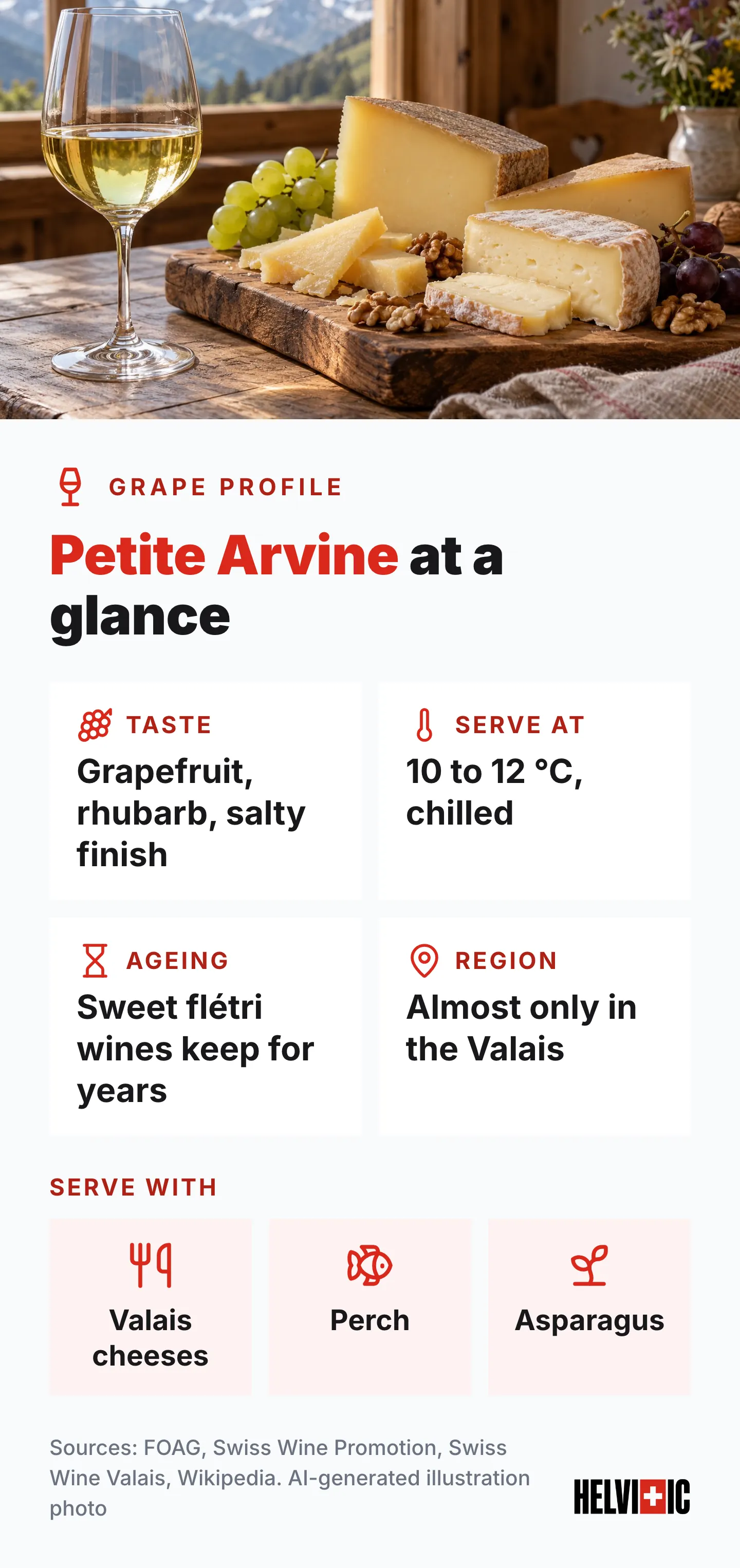
It smells of citrus, especially grapefruit, of rhubarb, sometimes passion fruit, with floral notes such as wisteria. Swiss Wine Promotion, the body that promotes Swiss wine, describes a lively attack, marked acidity softened by an almost creamy texture, and often a slight salty touch.
That salty edge is its signature, says Swiss Wine Valais, the Valais wine trade body, which speaks of a «finely iodine» hint. Swiss Wine Promotion puts it down to mineral-rich soils.
Young, the fruit leads. After a few years, the floral and mineral notes come through more.
Dry, off-dry or flétri: which Petite Arvine to choose?
Read the label, because Petite Arvine is made in several styles. The dry version, the most common, is lively and taut. A slightly off-dry version, with a little unfermented sugar, recalls rhubarb jam.
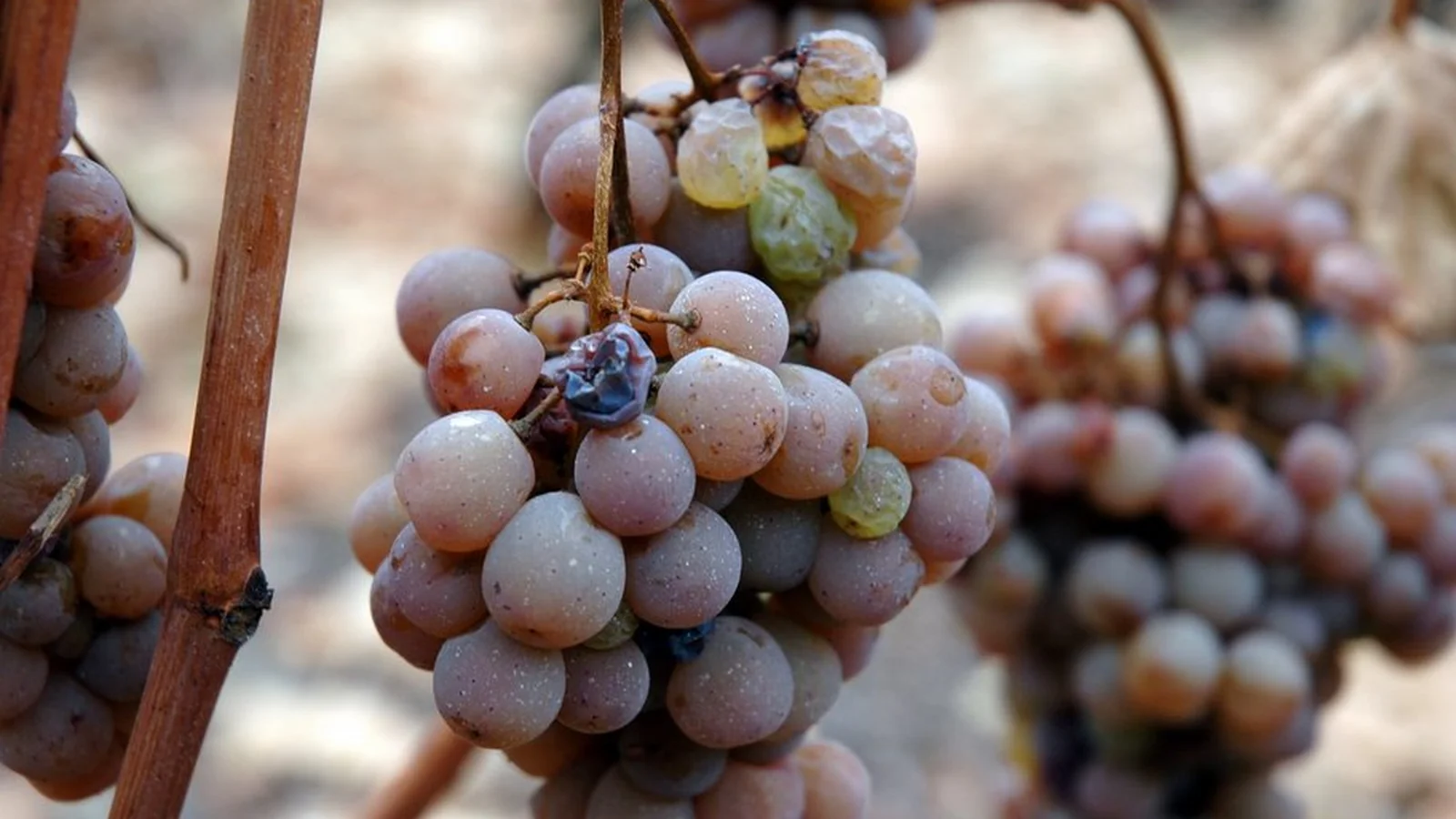
Flétri wines come from grapes left on the vine long after the usual harvest: the berries dry out, lose water and their sugar concentrates. The result is a sweet, very concentrated wine with exotic fruit aromas. Swiss Wine Promotion credits it with great ageing potential.
For apéritif and the meal, choose a dry one; to end the meal, a flétri.
Where does Petite Arvine grow, and why there?
Almost only in the Valais. According to the Federal Office for Agriculture (FOAG), nearly all the Swiss area is in that canton, and Petite Arvine is now the fifth white grape in the country. The charts on this page give the details.
It needs the best slopes. It ripens late and fears spring frost and wind, so it wants steep, sunny hillsides with well-drained limestone soils. Flat, damp plots do not suit it.
Fully and Chamoson have made it their speciality, according to Swiss Wine Promotion. Outside Switzerland, a little grows in the neighbouring Aosta Valley in Italy.
Where does Petite Arvine come from?
It is an old Valais grape. Swiss Wine Promotion says it has been grown in the Valais since the 17th century, and Swiss Wine Valais dates to 1602 the record that presents it as purely Valaisan.
Its parents are unknown: Swiss Wine Valais calls it an orphan grape. It remains demanding in the vineyard, with brittle young shoots and fragile leaves, which is why it only thrives on carefully chosen plots.
What to eat with it, and at what temperature?
Serve the dry version with a Valais cheese board: its salty touch answers the strong taste of local cheeses. It also suits freshwater fish such as perch or féra (a whitefish from Swiss lakes), whose delicate flavour it does not cover, and even asparagus, usually hard to match with wine.
It brings freshness to a coconut milk curry. Swiss Wine Valais also pairs it with scallops, salmon, lobster or oysters.
Serve it at 10 to 12 °C, as Swiss Wine Promotion recommends: slightly less cold than a Fendant, so that its aromas open up.
Vineyard area in Switzerland
Petite Arvine: official 2025 figures
- Area in Switzerland
- 280.3 ha
- Share of the Swiss vineyard
- 1.9 %
- Rank among white grapes
- 5th of 142
Key points
- Lively white: grapefruit, rhubarb, wisteria and a salty finish.
- Usually dry, sometimes off-dry, sweet when made as flétri.
- Almost only in the Valais; the fifth white grape in Switzerland according to the FOAG.
- Good with Valais cheeses, perch, asparagus and seafood.
- Serve at 10 to 12 °C; flétri wines keep for a long time.
- On Helvitic, orders open soon, straight from Valais wineries.
Frequently asked questions: Petite Arvine
What is Petite Arvine?
A white grape from the Valais, grown almost only in that canton. It makes lively wines with citrus and rhubarb aromas and a salty finish, either dry or sweet.
What does «AOC Valais» mean on a bottle?
AOC stands for appellation d'origine contrôlée, a controlled designation of origin: the wine comes from grapes picked in the Valais, made under the canton's production rules. It guarantees origin; it is not a quality ranking of wineries.
Why is Fully linked to Petite Arvine?
The village has made it its speciality, like Chamoson, according to Swiss Wine Promotion. Fully also hosts Arvine en Capitale, an event devoted to the grape.
Are Petite Arvine and Grosse Arvine the same grape?
No. Grosse Arvine is a separate and very rare grape. According to Swiss Wine Valais, Petite Arvine is its grandparent.
Sources
- Federal Office for Agriculture (FOAG), «L’anno viticolo 2025», Statistiche vitivinicole, as of November 2025 (PDF)
- Swiss Wine Promotion, grape variety profile: Petite Arvine (taste, history, soils, food pairings, 10 to 12 °C), checked on 21 October 2026
- Swiss Wine Valais, Petite Arvine (styles, briny touch, 1602, variety with no known relatives), checked on 21 October 2026
- Swiss Wine Valais, Petite Arvine (food and wine pairings), checked on 21 October 2026
- Wikipedia (French), Arvine: late ripening, fragility, Aosta Valley, Arvine en Capitale, checked on 21 October 2026