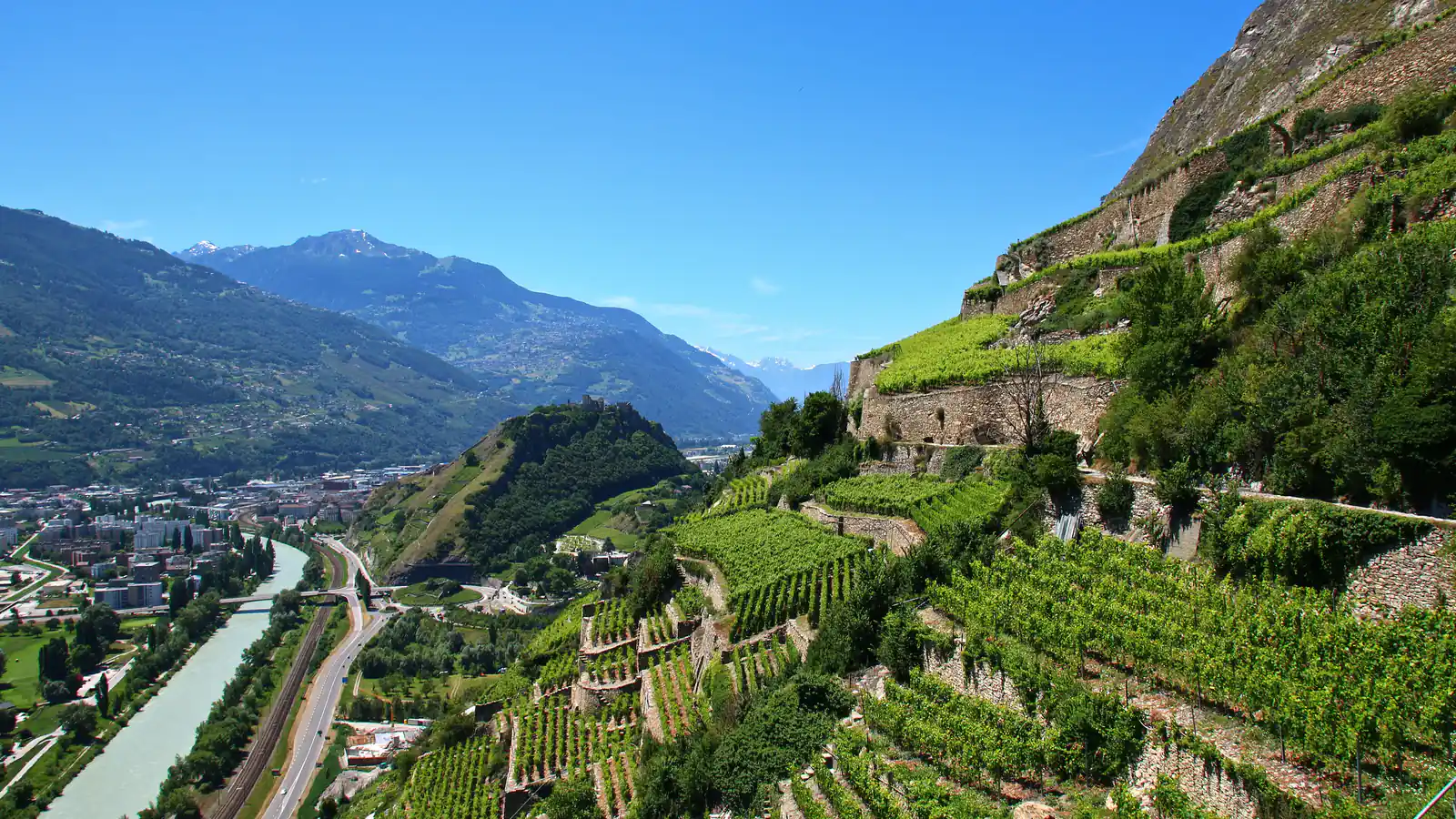
To get to know Valais wine, start with the grapes you will hardly find anywhere else: Petite Arvine for whites, Cornalin and Humagne Rouge for reds. Valais is Switzerland's largest wine canton, with 4,578 hectares of vines in 2025 according to the Federal Office for Agriculture (FOAG), close to a third of the country's vineyards.
The vineyards follow the Rhône from Port-Valais on Lake Geneva up to Brig, across more than sixty wine-growing communes, says Swiss Wine Valais, the canton's wine trade body. Pinot Noir and Fendant, the local name for the Chasselas grape, are the most planted.
Where are the Valais vineyards?
The vines cling to the slopes of the Rhône valley, often on terraces held up by dry stone walls. Swiss Wine Valais divides the area into three parts: Lower Valais, from Port-Valais to Leytron; Central Valais, from Chamoson to Sierre; and German-speaking Upper Valais, from Salgesch to Brig.
The vines climb high. According to Swiss Wine Promotion, the body that promotes Swiss wine, they reach 1,100 metres at Visperterminen, above Visp. In 2025 the FOAG counted 4,578 hectares of vines in Valais, 38 fewer than in 2024; the canton remains by far the largest, ahead of Vaud.
Why does the Valais climate suit vines so well?
Valais is a dry valley sheltered from rain by the Alps. Swiss Wine Promotion puts rainfall at about 650 mm and sunshine at 2,500 hours a year. Little rain means fewer fungal diseases on the grapes: Swiss Wine Valais notes that the climate naturally keeps mildew and rot in check.
In autumn the foehn blows, a warm, dry wind coming down from the mountains. It extends the ripening of late varieties such as Petite Arvine and Cornalin, which need a long autumn.
The terraces matter too. Swiss Wine Valais explains that the dry stone walls hold the soil, slow erosion and create many small microclimates, while lizards and insects live in the gaps. On these slopes, nearly all the work is still done by hand.
Which grapes should you try in Valais?
Valais is mostly red-wine country: 58% of the area, according to the FOAG. Pinot Noir leads with 1,222 hectares, a third of all Swiss Pinot Noir. Blended with Gamay, it makes Dôle, the canton's traditional red.
Among whites, Fendant dominates. It is drunk young and fresh, with raclette or as an aperitif. Johannisberg, the Valais name for Sylvaner, is the second white grape. Swiss Wine Valais describes it as richer and denser than Fendant, with notes of peach, flint and honey; it ripens very late and needs the warmest plots.
What sets Valais apart are its specialities. FOAG figures show that over 99% of Switzerland's Petite Arvine, Cornalin, Humagne Rouge and Amigne grows here. Petite Arvine makes a lively white with citrus notes and a salty finish; Cornalin a velvety, fruity red. Heida (also called Païen, the Valais name for Savagnin Blanc), Syrah and Humagne Blanche complete the range. Swiss Wine Valais counts 55 grape varieties allowed under the AOC.
Our pages on Petite Arvine, Cornalin, Humagne Rouge, Heida and Fendant cover each grape in detail, with planted areas and food pairings.
What do AOC Valais and Grand Cru guarantee?
Every appellation wine from the canton carries the words AOC Valais. AOC stands for appellation d'origine contrôlée, a protected designation of origin: the grapes come from a defined area and follow a set of rules on permitted varieties, maximum yields and minimum sugar content. Swiss Wine Valais points out that the cantonal wine ordinance requires this to appear clearly on the front label.
Grand Cru goes further. It is voluntary and run by ten communes, each choosing which grapes may be grown on its best plots. The rules, as set out by Swiss Wine Valais: vines at least 8 years old, lower yields, higher natural sugar than standard AOC, winemaking and bottling in Valais, and approval every year by a tasting panel.
The ten communes and their Grand Cru grapes: Chamoson (Johannisberg, Petite Arvine, Pinot Noir, Syrah), Conthey (Fendant, Heida, Pinot Noir, Cornalin), Leytron (Fendant, Humagne Blanche, Humagne Rouge, Cornalin), Saillon (Petite Arvine, Humagne Rouge, Cornalin, Syrah), Salgesch (Pinot Noir, Dôle, Cornalin, Syrah), Sierre (Petite Arvine, Ermitage, Cornalin, Syrah), Sion (Fendant, Ermitage, Dôle, Syrah), Saint-Léonard (Fendant, Pinot Noir), Vétroz (Fendant, Amigne, Pinot Noir, Gamay) and Visperterminen (Heida). Ermitage is the Valais name for Marsanne, a white grape.
Which villages and landscapes are worth a visit?
The Vineyard Trail (Chemin du vignoble) crosses the wine country from Martigny to Leuk over more than 65 kilometres, in four stages: Branson–Saillon, Saillon–Sion, Sion–Venthône and Venthône–Leuk, according to Valais/Wallis Promotion, the canton's tourist board. Stations at Martigny, Sion, Sierre, Salgesch and Leuk make it easy to walk one day at a time.
Above Sion, the Bisse de Clavau path follows an old irrigation channel through the terraces; that is the view in the photo at the top of this page. Vétroz is the home of Amigne, Fully the village of brisolée, an autumn meal of roasted chestnuts, Visperterminen the village of mountain vines.
Where can you taste Valais wine?
The Valais Open Cellars (Caves ouvertes) take place every year over the Ascension weekend. Swiss Wine Valais says it started in 2007 with 99 cellars; today more than 230 open their doors, with shuttle buses linking some villages.
All year round, the Valais Vine and Wine Museum tells the story of the vineyards at two sites: the Wine Museum in Sierre for temporary exhibitions and the Zumofen House in Salgesch for the permanent one. An 8-kilometre vineyard path joins them, with panels on the grapes; it hosts the Marche des cépages, a wine walk that draws up to 9,000 visitors according to Swiss Wine Valais.
Valais wine on Helvitic
Helvitic connects wineries and wine lovers directly, with no reseller in between. Sales are not open yet: payment is still being tested. Meanwhile you can browse the Valais wineries already on Helvitic, save them as favourites and follow them to hear about new wines and events.
Once ordering opens, you will order in multiples of 6 bottles; every bottle will ship straight from the winery that made it, delivered to you or ready for pick-up at the cellar.
Source: Federal Office for Agriculture (FOAG), «L’anno viticolo 2025», Statistiche vitivinicole, tables 1.2 and 1.3, as of November 2025. Hectares rounded to one decimal (published in ares). Shares calculated by Helvitic, first on the area of the region, then on the total Swiss vineyard area (14,431.0 ha). Read the statistics (PDF in Italian)
Key points
Switzerland's largest wine canton: 4,578 ha in 2025, close to a third of all vineyards.
Dry, sunny climate, autumn foehn wind, terraced vines up to 1,100 m.
58% red; Pinot Noir and Fendant lead, followed by Gamay and Johannisberg.
Grapes found almost only here: Petite Arvine, Cornalin, Humagne Rouge, Amigne.
One AOC Valais, plus Grand Cru in ten communes with stricter rules and yearly checks.
Sales on Helvitic are not open yet; you can already follow the wineries.
A Fendant, the Valais name for Chasselas: dry and fresh, it cleans the palate between portions of melted cheese. Swiss Wine Valais says Fendant and Gamay are the most popular choices with raclette; Heida suits more mature cheeses.
Does Valais make more red or white wine?
More red: 58% of the area in 2025 according to the FOAG, against 42% white. Pinot Noir is the most planted grape, ahead of Chasselas, which is called Fendant in Valais.
What is Johannisberg?
The Valais name for Sylvaner, a white grape. With 331 hectares according to the FOAG, it is the canton's second white grape after Fendant. It makes richer wines than Fendant, with notes of peach and honey.
What does Grand Cru mean on a Valais wine?
The wine comes from a defined plot in one of the ten Grand Cru communes, from a grape chosen by the commune, from vines at least 8 years old and with lower yields than standard AOC. Every wine must be approved by a tasting panel.
When are the open cellar days in Valais?
Every year over the Ascension weekend. More than 230 cellars take part according to Swiss Wine Valais, and shuttle buses connect some of them.