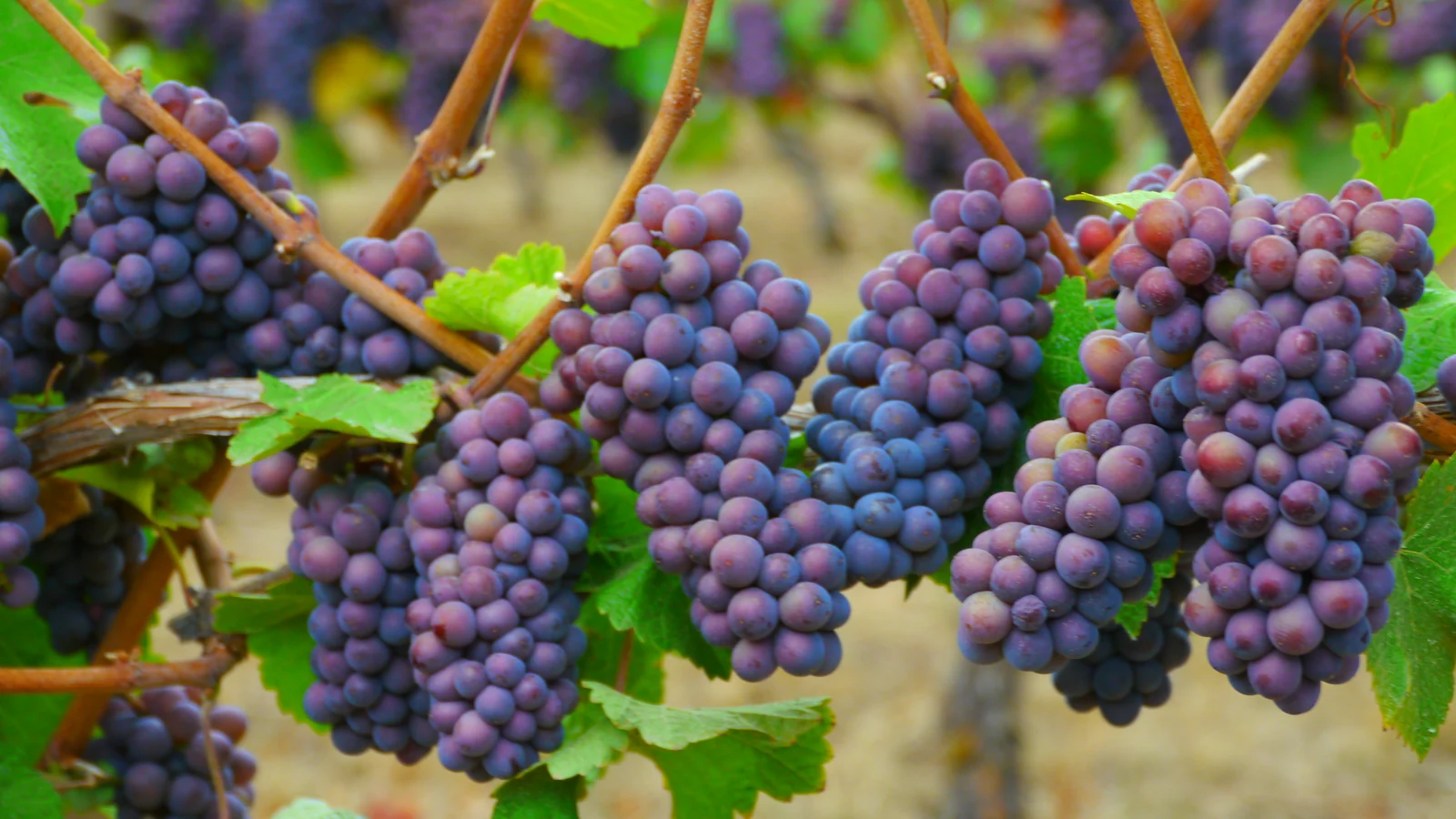
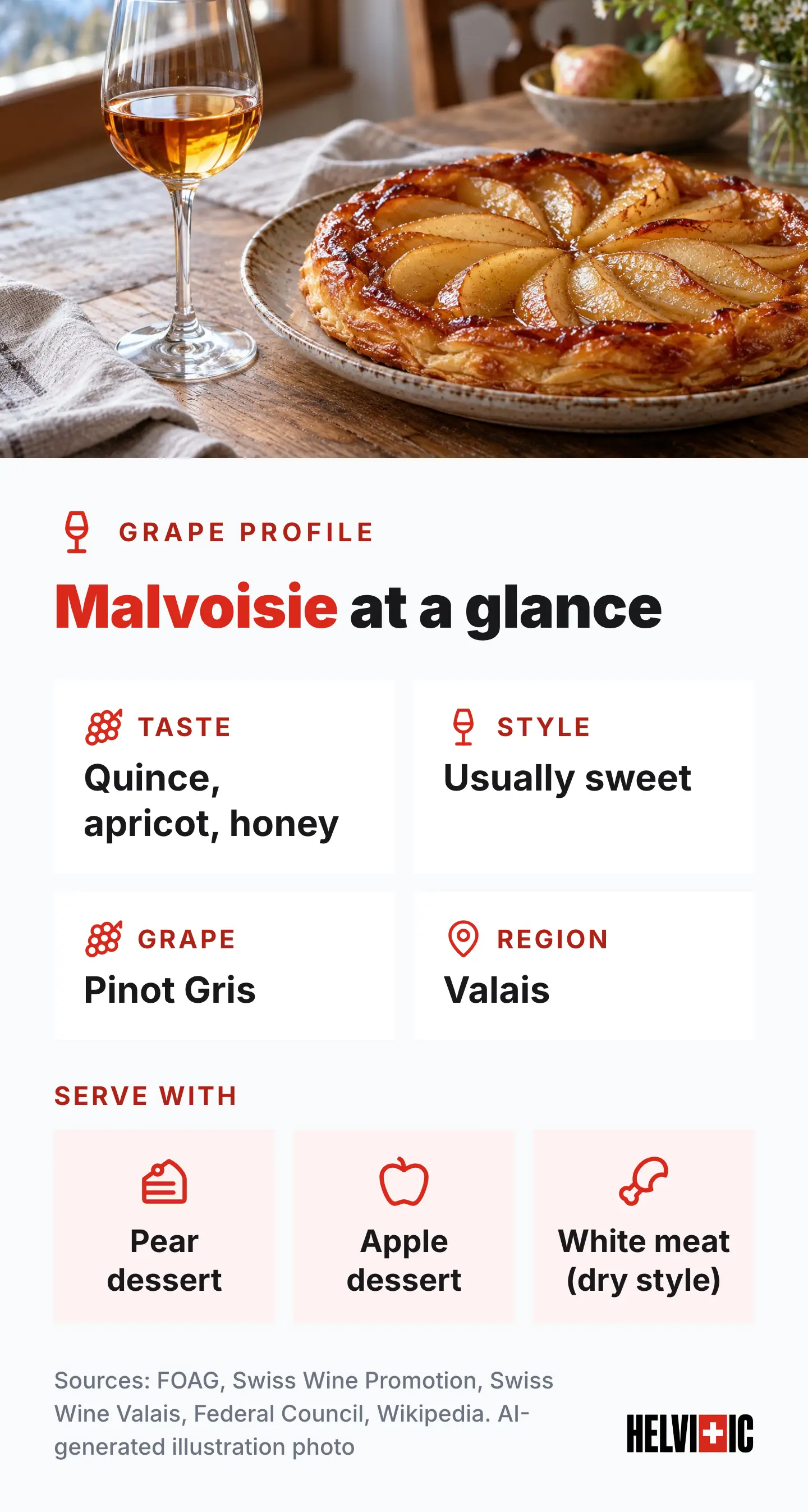
Serve a Valais Malvoisie with a pear or apple dessert: this white, usually sweet, smells of quince, apricot and honey. It is Pinot Gris, which the Valais, a canton in south-west Switzerland, calls Malvoisie and picks very ripe. On Helvitic you will buy it straight from Valais wineries.
Orders are not open yet: online payment is still in its test phase. Once it opens, each winery sells its own bottles.
Are Malvoisie and Pinot Gris the same grape?
Yes. Pinot Gris is a colour mutation of Pinot Noir, a variant with greyish-pink skin that appeared on its own. Swiss Wine Promotion, the body that promotes Swiss wine, records it in Germany in 1711 as Ruländer. German-speaking Swiss call it Grauburgunder; in the Valais it is Malvoisie.
The Valais borrowed the name from Italian Malvasia, famous for sweet wines, though the two are not related. Malvoisie appears in a Valais recipe book written between 1671 and 1698; in 1869 the Zurich chemist Kohler identified it as Pinot Gris, Swiss Wine Valais, the trade body for Valais wines, notes.
‘Malvoisie du Valais’ is now one of the traditional names protected by the Swiss federal wine ordinance. The Federal Office for Agriculture (FOAG) counts Pinot Gris and Malvoisie together: the Valais has just under a quarter of Swiss Pinot Gris.
Is Malvoisie dry or sweet?
Usually sweet. According to Swiss Wine Valais, Malvoisie is almost always picked overripe, sometimes with noble rot: a fungus that pierces the grape skin and dries the berry, concentrating the juice. The result is rich, concentrated wine smelling of quince jelly, mirabelle plum jam, honey and candied fruit.
Looking for a dry one? They exist, with hazelnut notes and a slight bitterness, according to Swiss Wine Promotion. But they are rare, and in the Valais they are usually labelled Pinot Gris.
What does ‘flétri’ mean on the label?
It is a term defined by the Swiss federal wine ordinance. A ‘flétri’ or ‘flétri sur souche’ is a sweet wine from grapes dried on the vine: they are left hanging into late autumn, lose water, and their sugar concentrates.
The rules are strict: at least 13% potential alcohol, no added alcohol, sugar or grape concentrate, and sugar left over after a natural fermentation. Terms such as ‘mi-flétri’ or ‘semi-flétri’ are not allowed.
What food goes with Malvoisie?
Serve sweet Malvoisie with a pear or apple puff-pastry dessert, as Swiss Wine Promotion suggests. Pick a dessert that is not too sweet: the wine brings its own sweetness, and a very sugary cake would make it taste flat.
Dry versions suit white meat and mushroom dishes. Swiss Wine Valais says its power turns into harmony after a few years in the cellar, so there is no rush to open it.