
Serve a Ticino Merlot with risotto, pasta in tomato sauce or grilled red meat: this dry red with dark fruit, plum and spice aromas has soft tannins. Ticino, the Italian-speaking canton south of the Alps, holds more than two thirds of the Swiss area of this grape. On Helvitic you will buy it straight from the wineries; orders open soon.
Merlot from Ticino
The red of Italian-speaking Switzerland, and even a white
On this page
What does Ticino Merlot taste like?
Expect a dark colour with slightly purple glints, then aromas of dark fruit, plum and spice. Swiss Wine Promotion, the body that promotes Swiss wine, describes Swiss Merlot as full-bodied and fruity, with soft tannins and a good balance between fruit and power.
It is a dry wine: it is made without residual sugar, meaning no sugar is left after fermentation, according to Swiss Wine Promotion.
Styles range from fruity reds to powerful cuvées aged in barrique, a small oak barrel.
Why did Merlot settle in Ticino?
Ticino is the only Swiss wine region south of the Alps. According to Swiss Wine Promotion, its heavy rainfall, generous sunshine and climate with maritime influences favoured Merlot, which covers nearly 80 % of the Ticino vineyard.
The grape comes from the Bordeaux region of France. In Switzerland it was first planted in Vaud in the mid-19th century, then reached Ticino in the early 20th century.
According to the Federal Office for Agriculture (FOAG), it is now the second red grape in Switzerland after Pinot Noir. More than two thirds of the area is in Ticino; the Valais comes far behind, ahead of Vaud and Geneva. The charts on this page give the details.
Sopraceneri or Sottoceneri: which Merlot to choose?
Check where the bottle comes from. The Monte Ceneri pass splits Ticino into two wine areas, and Swiss Wine Promotion describes different styles for each.
In the north, the Sopraceneri, vines often grow on steep terraces with granite and schist soils. The cooler, Alpine-influenced climate gives more elegant, finer Merlots, fresh and mineral.
In the south, the Sottoceneri, the climate is warmer and Mediterranean, with clay and limestone soils. Merlots there are more powerful and structured, often aged in barrique, rounder and more intense.
What is Merlot Bianco?
A white wine made from red Merlot grapes. Grape juice is clear and the colour sits in the skin: separate the juice from the skins quickly and you get a white wine. Swiss Wine Promotion describes it as an elegant white that is winning more and more fans in Ticino.
What to eat with Merlot, and at what temperature?
Serve it with risotto, pasta such as lasagne or spaghetti bolognese, pizza, or Mediterranean dishes with tomatoes and grilled vegetables: its soft tannins and fruit suit them well, according to Swiss Wine Promotion.
It also goes with grilled or raw red meat, beef fillet, tartare or carpaccio, lamb, game, duck breast, and aged cheeses such as Gruyère or Tomme vaudoise.
Serve it at 16 to 18 °C, as Swiss Wine Promotion recommends: a little below the temperature of a heated room, which is often too warm for red wine.
Vineyard area in Switzerland
Merlot: official 2025 figures
- Area in Switzerland
- 1,191.6 ha
- Share of the Swiss vineyard
- 8.3 %
- Rank among red grapes
- 2nd of 172
Key points
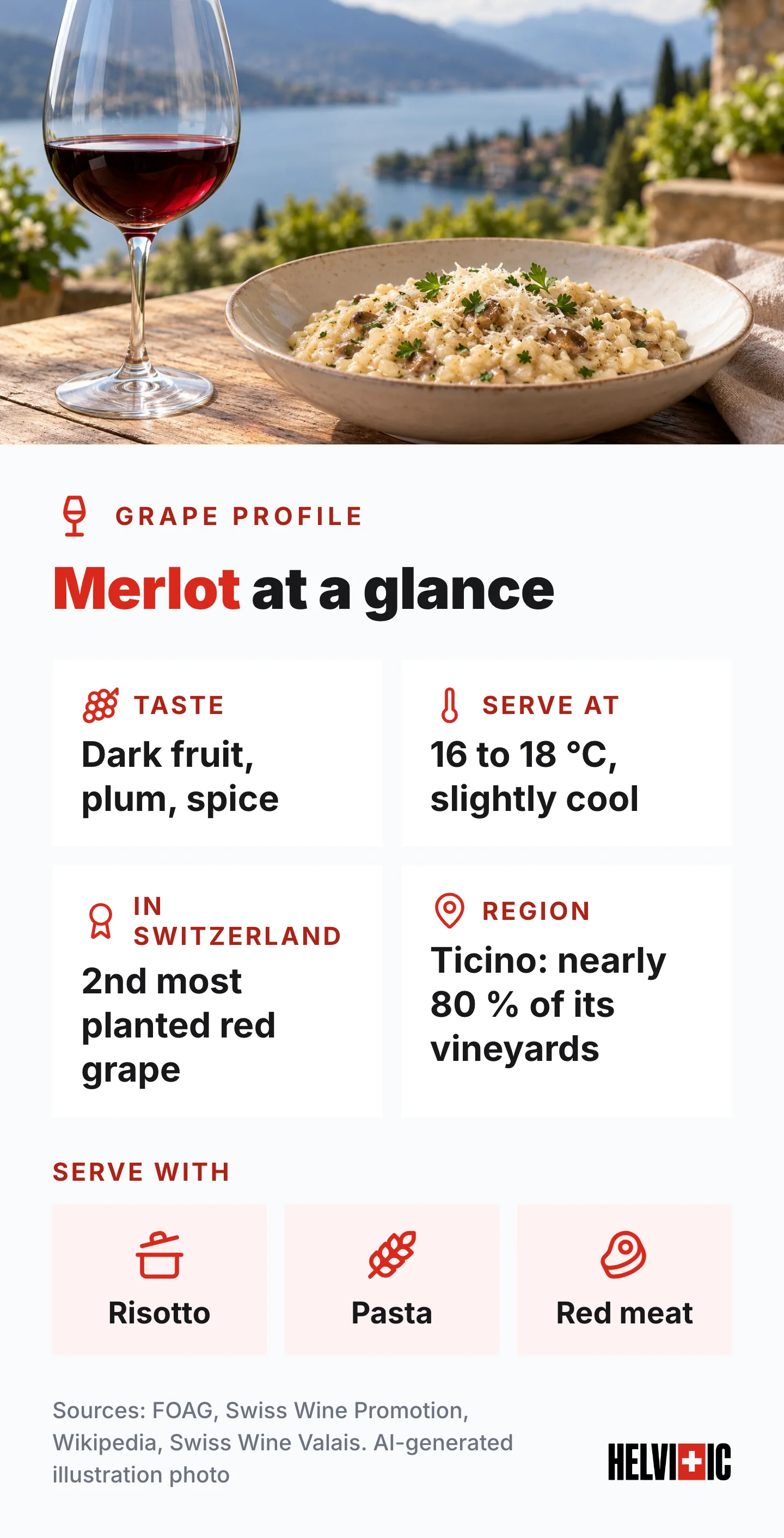
- Dry, full-bodied red: dark fruit, plum, spice, soft tannins.
- The second red grape in Switzerland according to the FOAG; more than two thirds in Ticino.
- Nearly 80 % of the Ticino vineyard; from Bordeaux, via Vaud in the 19th century.
- Sopraceneri: finer and fresher; Sottoceneri: more powerful, often oak-aged.
- With risotto, pasta, red meat and aged cheese; serve at 16 to 18 °C.
- On Helvitic, orders open soon, straight from the wineries.
Frequently asked questions: Merlot
What is the best Ticino Merlot?
There is no single answer. Choose the style first: Sopraceneri for elegance and freshness, Sottoceneri for power. In Ticino, the VITI quality label also marks wines that have passed a tasting panel.
Is Merlot a Swiss grape?
No, it comes from the Bordeaux region. But it has been grown in Switzerland since the mid-19th century and has become the signature grape of Ticino.
Is there Merlot outside Ticino?
Yes. According to the FOAG, the Valais, Vaud and Geneva grow it too, though far less than Ticino. The charts on this page show the split by canton.
Sources
- Federal Office for Agriculture (FOAG), «L’anno viticolo 2025», Statistiche vitivinicole, as of November 2025 (PDF)
- Swiss Wine Promotion, grape variety profile: Merlot (taste, dry, Merlot Bianco, Vaud in the 19th century, food pairings, 16 to 18 °C), checked on 21 October 2026
- Swiss Wine Promotion, Ticino wine region (nearly 80 % Merlot, Sopraceneri and Sottoceneri), checked on 21 October 2026
- Wikipedia (German), Weinbau in der Schweiz: Merlot introduced in Ticino in the early 20th century, VITI label, checked on 21 October 2026
- Swiss Wine Valais, serving temperatures (heated room too warm for a red), checked on 21 October 2026