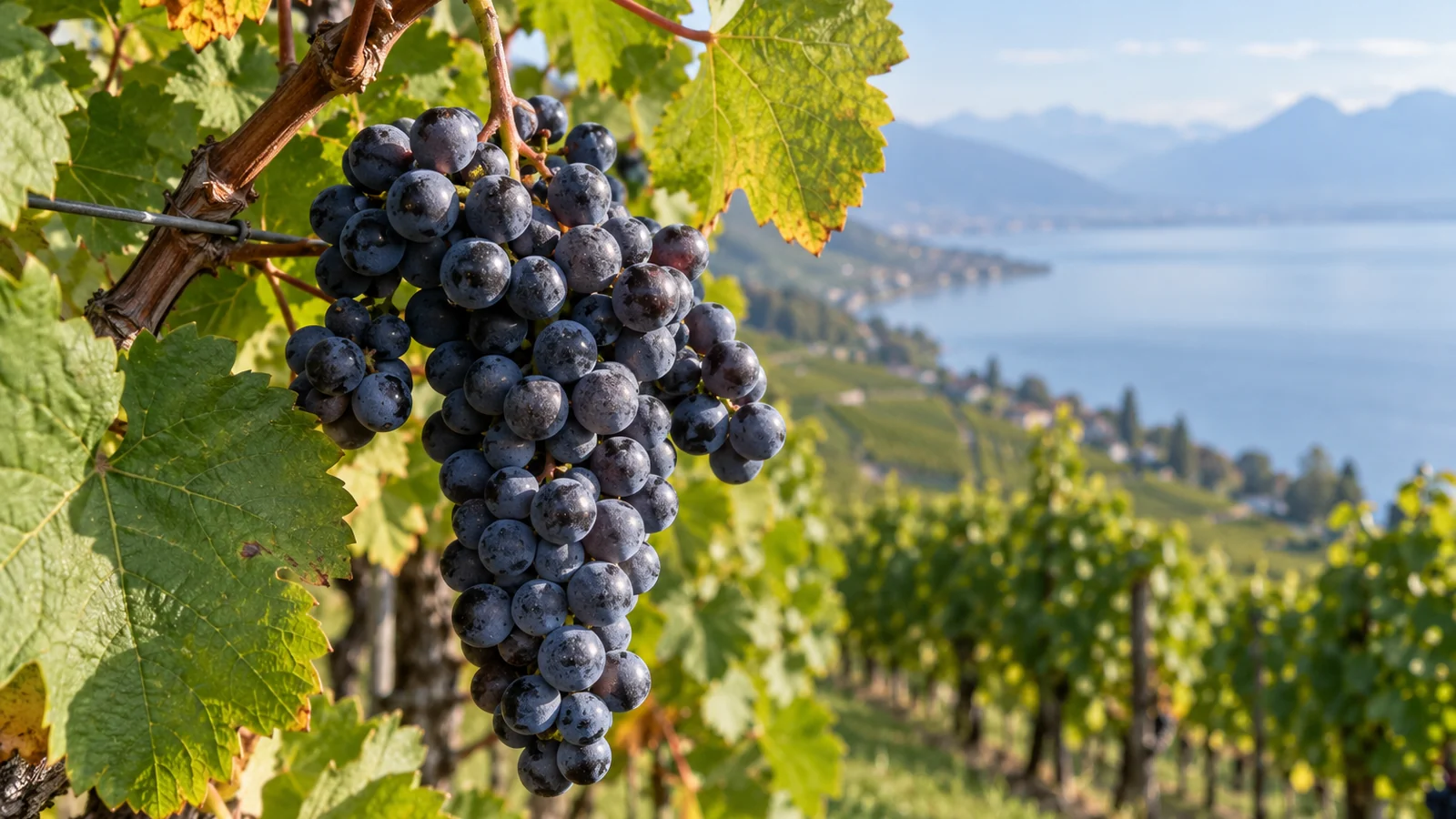
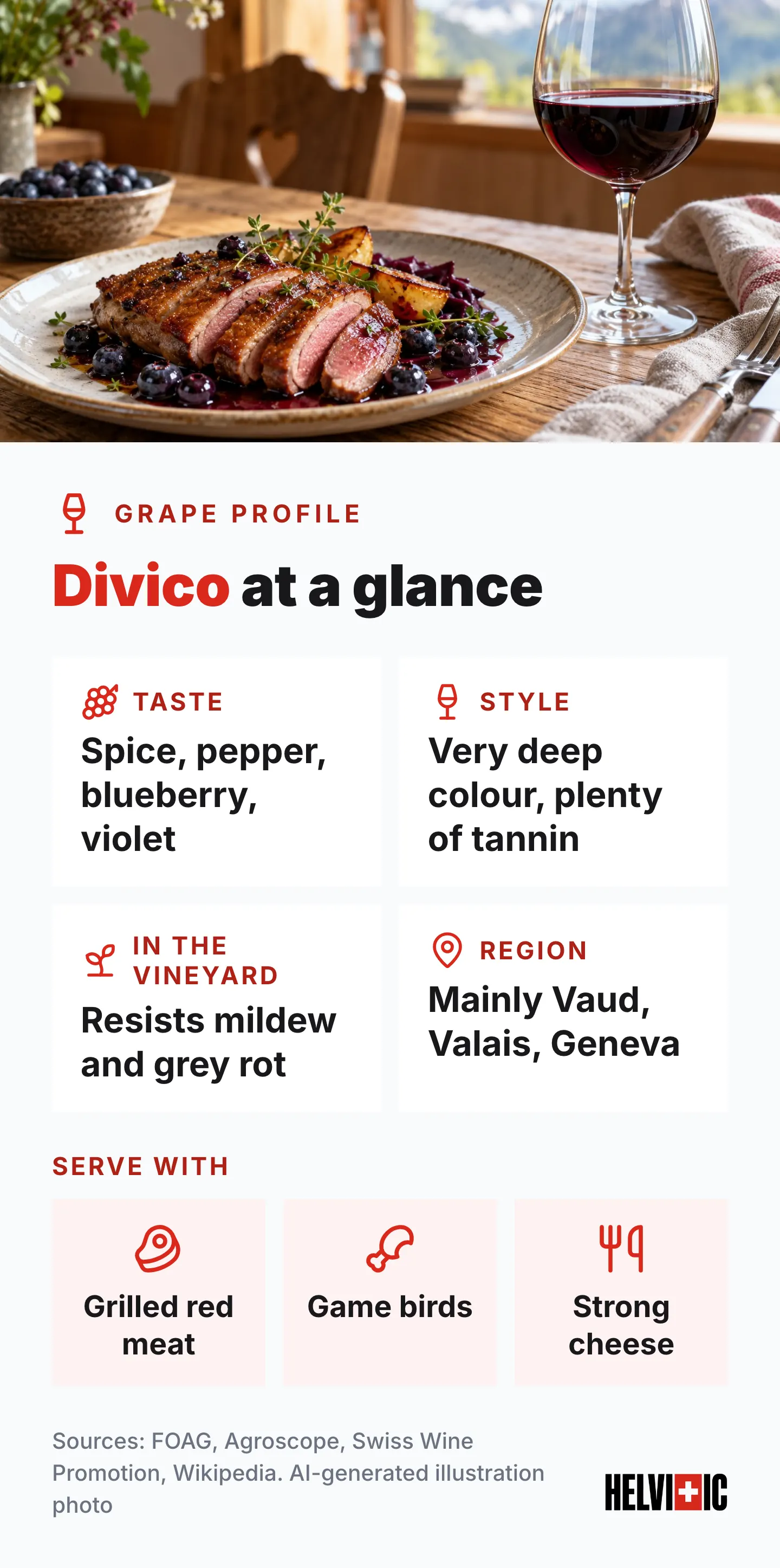
Try a Divico with grilled red meat or a strong cheese: this deep-coloured Swiss red shows spice, blueberry and violet, with plenty of tannin. Agroscope, the Swiss federal agricultural research centre, bred it to resist the main vine diseases, and it now grows all over Switzerland. On Helvitic you will buy it straight from the winery.
Orders are not open yet: online payment is still in its test phase. Once it opens, each winery sells its own bottles.
What is a disease-resistant grape?
It is a variety that copes with the fungi that attack vines: downy mildew, which hits leaves and bunches in wet weather, powdery mildew, which coats them in white dust, and grey rot, which makes the grapes go mouldy. Growers can then spray far less. In German-speaking Switzerland these grapes are called PIWI.
Agroscope presented Divico in 2013 as its first red grape with high resistance to all three diseases. It recommends one to three treatments around flowering, depending on how much disease the year brings.
Resistant does not mean immune: Agroscope's technical sheet says Divico has no particular resistance to black rot or to rotbrenner, two other vine diseases.
Where does Divico come from?
It is a cross of Gamaret, a red grape Agroscope bred in 1970, and Bronner, bred by the state wine institute in Freiburg im Breisgau, Germany. Bronner carries resistance genes from wild American and Asian vines. The cross dates from the late 1990s and long went by the code IRAC 2091.
Breeding takes years: in each cross only 3 to 5% of the seedlings are resistant enough, according to Agroscope. Vine nurseries have sold Divico since 2015. The Federal Office for Agriculture (FOAG) now counts it in almost every wine-growing canton; none has more than three in ten hectares.
What does Divico taste like?
Swiss Wine Promotion, the body that promotes Swiss wine, describes very deep-coloured wines with aromas of spice, pepper, clove, blueberry and violet, and plenty of good-quality tannin. Agroscope compares the quality of its wines to Gamaret, its parent.
The grapes are picked late, like Gamaret: according to Agroscope, the long ripening improves the structure and the tannins. Divico is made on its own or blended with other grapes.
What food goes with Divico?
Serve it with grilled red meat, game birds such as pheasant or wild duck, or a strong cheese, as Swiss Wine Promotion suggests. Its abundant tannins need a dish with flavour and texture. With fish or light poultry they would take over.
Why is it called Divico?
It is named after Divico, a chief of the Tigurini, one of the tribes of the Helvetii, the Celtic people of ancient Switzerland. Julius Caesar writes in his Gallic War that Divico defeated a Roman army in 107 BC, then led the Helvetian embassy to Caesar himself in 58 BC.