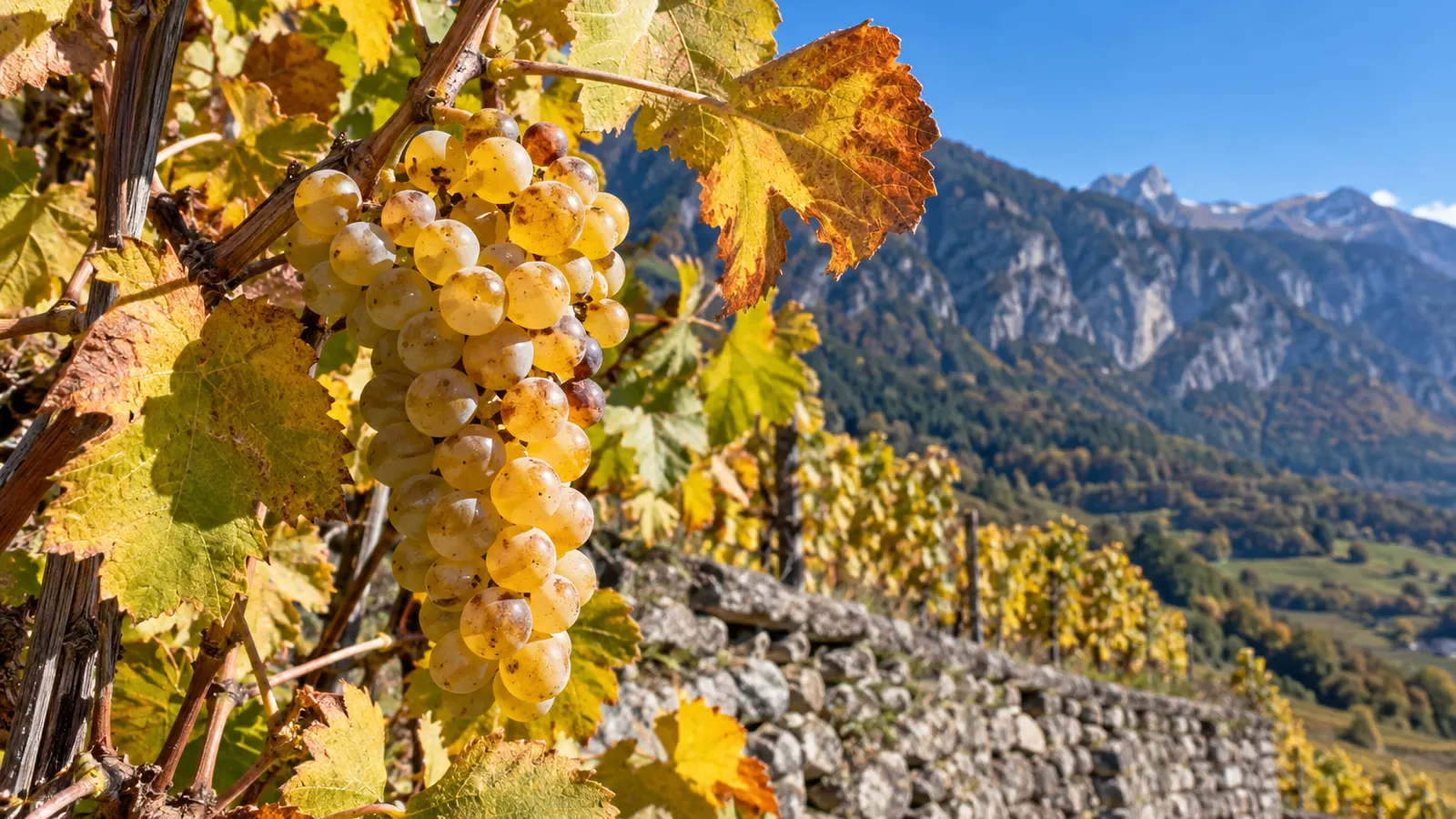
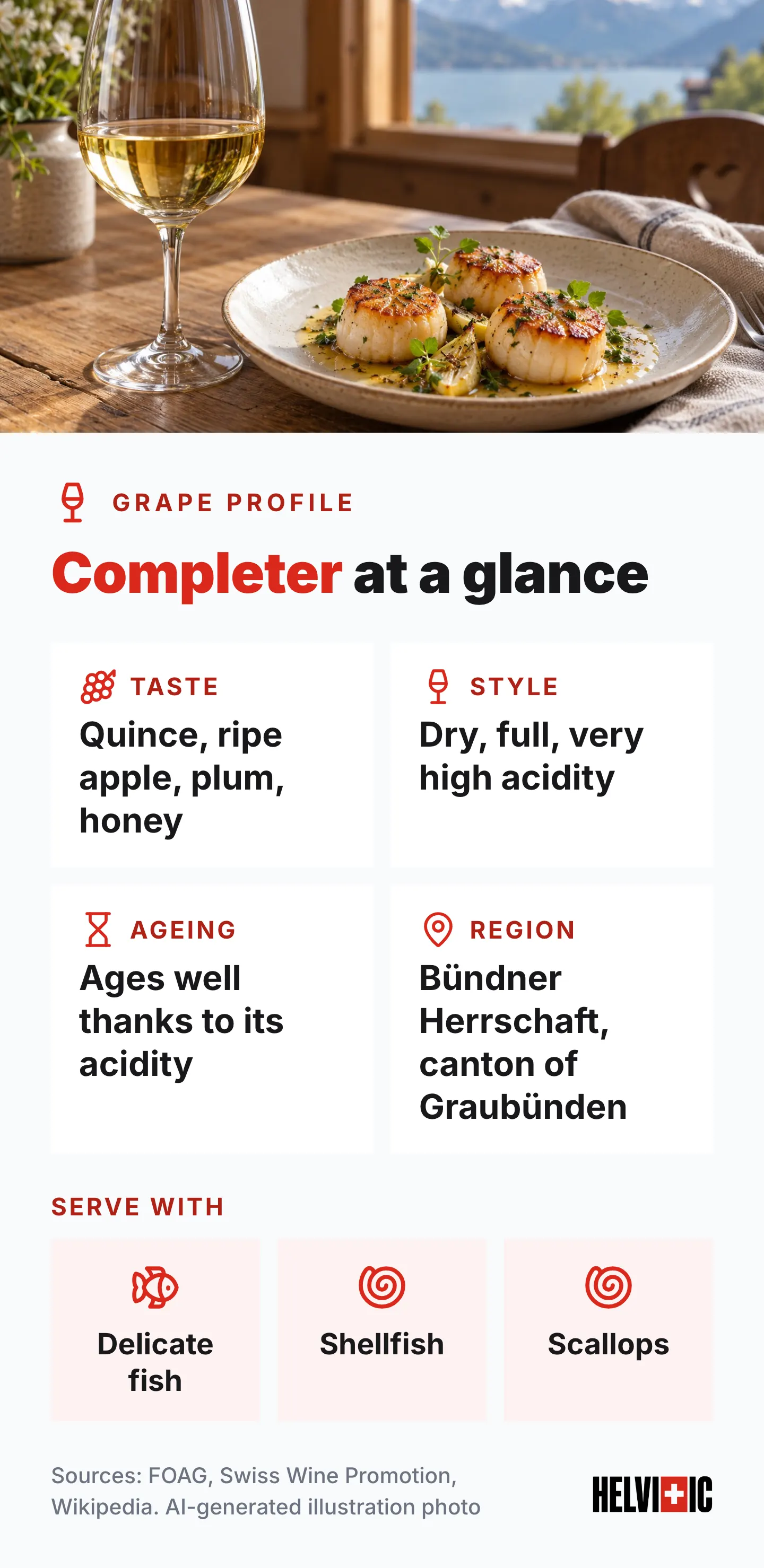
Save a Completer for fine fish or scallops: this dry white from Graubünden, Switzerland's south-eastern canton, is full and very fresh, with quince, ripe apple and honey. Recorded in Malans in 1321, it is still rare and grows mostly in the Bündner Herrschaft. On Helvitic you will buy it straight from the winery.
Orders are not open yet: online payment is still in its test phase. Once it opens, each winery sells its own bottles.
What does Completer taste like?
Swiss Wine Promotion, the body that promotes Swiss wine, describes complex aromas of quince, ripe apple, plum and honey. On the palate it is fully dry and broad.
Its signature is a very high natural acidity, the freshness that makes your mouth water. It also tends slightly towards oxidation: in contact with air it takes on a more mature character. This is a powerful white, far from a light apéritif wine.
Why is it called Completer?
The name comes from the Latin completorium, Compline, the monks' last prayer of the day. According to Swiss Wine Promotion, Benedictine monks were then allowed a glass of it in silence. Wikipedia links the custom to the monks of the cathedral chapter in Chur.
Vines are recorded in Malans as early as 926, but Completer is only named there in 1321.
Where does Completer grow?
Mostly in the Bündner Herrschaft, the wine area in the north of Graubünden, around Malans and Fläsch. A late-ripening grape, it benefits from the Föhn, a warm, dry wind that blows down from the Alps. According to the Federal Office for Agriculture (FOAG), Graubünden has more than half of the Swiss area and the Valais about a quarter.
It had almost disappeared by the 1960s, when its sharp acidity fell out of fashion. Research also showed it had survived in the Upper Valais under the wrong names ‘Kleiner’ and ‘Grosser Lafnetscha’. Lafnetscha, another Valais rarity, is in fact the offspring of Humagne Blanche and Completer.
What food goes with Completer, and how long does it keep?
Serve it with delicate fish such as turbot, sole or John Dory, with langoustines or scallops, as Swiss Wine Promotion suggests. Its acidity cuts through a butter sauce and the richness of shellfish.
The same acidity gives it great ageing potential, according to Swiss Wine Promotion. Our Humagne Blanche page covers Lafnetscha's other parent, another old Valais white.