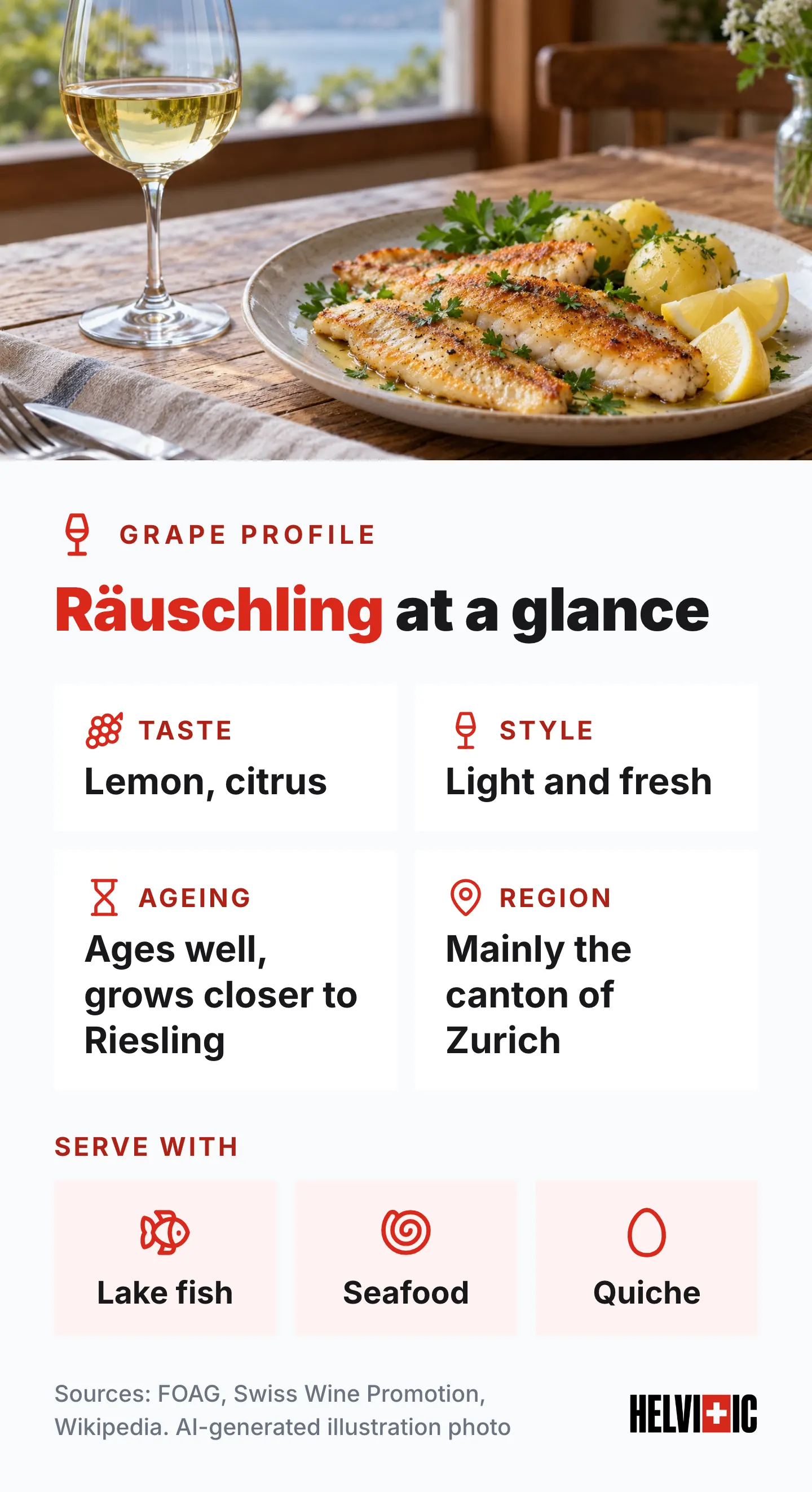
Open a Räuschling with perch or trout from the lake: this light, fresh white, with lemon and citrus notes, does not drown the fish. The old grape now grows almost only in German-speaking Switzerland, mainly in the canton of Zurich. On Helvitic you will buy it straight from the winery.
Orders are not open yet: online payment is still in its test phase. Once it opens, each winery sells its own bottles.
What does Räuschling taste like?
Swiss Wine Promotion, the body that promotes Swiss wine, describes a light wine with citrus and lemon notes and usually high acidity, the freshness that makes your mouth water. Räuschling most likely inherited it from its parents.
It is a dry, thirst-quenching white rather than an aromatic one. In the cellar, though, it evolves until it recalls a Riesling.
Where does Räuschling come from?
It is an old German grape from around Landau, in Rhineland-Palatinate, first recorded in 1546, according to Swiss Wine Promotion. A parentage test showed it is a natural cross of Gouais and Savagnin, two grapes that were widespread in medieval Europe.
Its name probably comes from the German verb rauschen, the rustle of wind in its dense leaves. It once grew in Württemberg, Alsace and northern Switzerland.
Why does it survive only in German-speaking Switzerland?
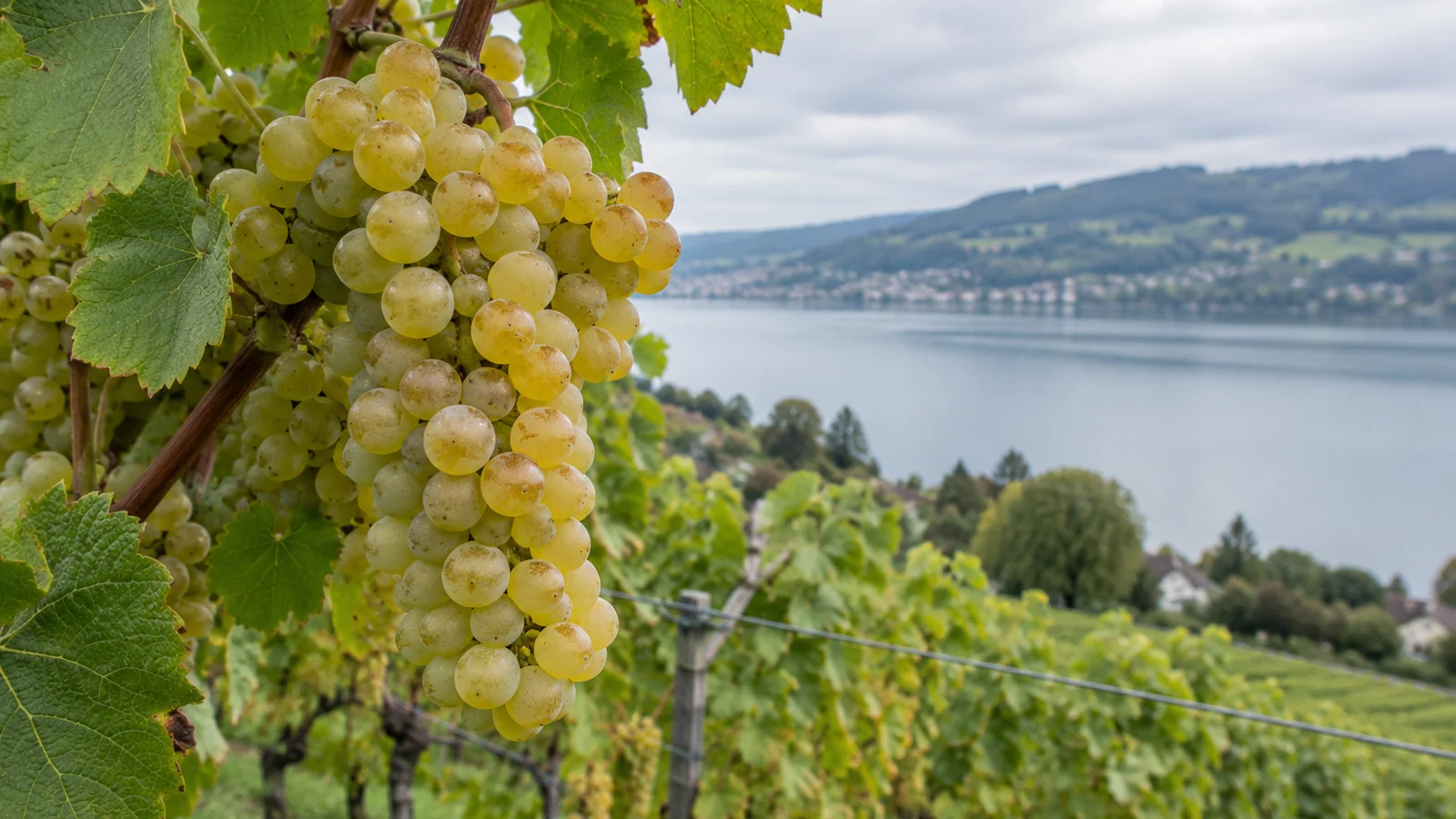
In recent decades many growers replaced it with Müller-Thurgau, which yields more and ripens earlier. It has almost vanished from its home region. Its old names, Zürirebe and Züriwiss, show where it held on: around Lake Zurich.
According to the Federal Office for Agriculture (FOAG), the canton of Zurich has nearly three in four hectares of Räuschling; Schwyz and St. Gallen follow far behind. The charts on this page show the detail.
What food goes with Räuschling, and does it age?
Serve it with lake and river fish, seafood or shellfish, as Swiss Wine Promotion suggests, or with savoury pastries and quiches. Its freshness and lightness let the delicate taste of perch or trout come through.
It ages well: Swiss Wine Promotion speaks of an impressive ageing potential, with the years making it taste more and more like a Riesling. Keep a bottle or two in the cellar to compare.